





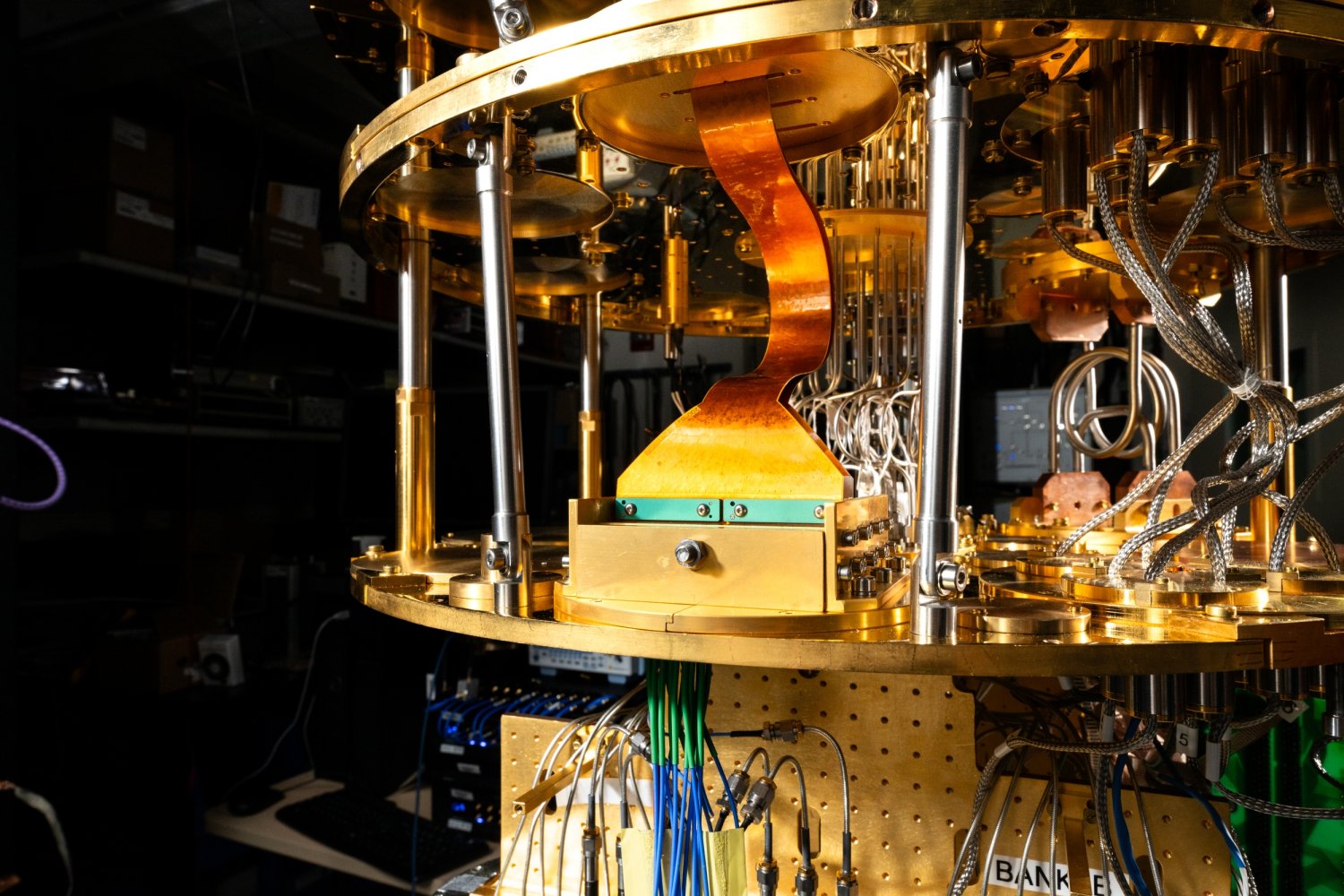
Scientists and engineers globally are leveraging quantum mechanics to create systems with remarkable capabilities. A significant focus is on developing quantum computers that can perform intricate calculations at unprecedented speeds, meeting the rising computational needs of scientific research and data-heavy sectors such as finance, cybersecurity, and medicine.
Quantum system development requires a stable environment for quantum bits (qubits) and reduced thermal noise in superconducting electronics. This necessitates cryogenic temperatures, between 5 and 10 millikelvins, which are colder than space. Dilution refrigerators provide these conditions and require wiring systems that function at cryogenic temperatures, support efficient direct current, and enable high-speed data transfer. MIT Lincoln Laboratory researchers have created flexible, ribbon-like, low-frequency (LF) cables that fulfill these requirements and are compatible with commercial circuit-board production. Maybell Quantum, a company in Colorado, has licensed these cables for their dilution refrigerators.
“We plan to use the Maybell LF CryoTrace, a ribbon wiring system from MIT Lincoln Laboratory, at all thermal stages of our dilution refrigerators,” stated Lasse Nielsen, strategy and operations lead at Maybell Quantum. Initially, these cables will serve LF functions like thermometry, heaters, and sensors, with future studies for additional uses. LF CryoTrace will be incorporated in the next version of our internal wiring after qualification testing.”
To aid government projects in quantum computing, the Lincoln Laboratory team explored alternatives to traditional coaxial cables for hardware like dilution refrigerators. Coaxial cables create significant heat loads for cryogenic hardware. As quantum computers expand in qubits, the infrastructure will require more coaxial cables, complicating hardware integration. The team opted for stripline cables, featuring conductive layers between flexible polymer layers to shield against electromagnetic interference. These striplines offer consistent performance across frequencies and minimize signal loss while supporting direct-current operation without warming the cryogenic environment.
“The main innovation is that our cables can be produced by a standard printed-circuit-board manufacturer. They’re more cost-effective and easier to install than traditional coaxial cables,” said John Cummings, a principal investigator in MIT Lincoln Laboratory’s flexible cables project. Maybell Quantum highlights that the ribbon format’s mechanical robustness reduces handling-related breakages common with thin coaxials and improves production consistency, allowing assembly tasks to be completed faster.
“We believe that over time, ribbonized, quantum-specific internal wiring can transform manufacturing norms, leading to faster, more consistent builds and easier field service,” Nielsen stated. Maybell Quantum aims to aid quantum computing’s shift from laboratory settings to industrial applications. Bridging the gap between specialized quantum labs and the infrastructure necessary for commercial quantum computing relies on hardware advancing functional chip development.
Maybell Quantum’s mission is to create reliable tools for commercial quantum computer developers, minimizing costs and the need for specialized training. The continued R&D of flex cables and their integration into various tools will support future infrastructure, enabling industries to scale quantum computer production cost-effectively. “For scaling to hundreds of chips, you need interconnects that handle more signals reliably. The Lincoln Laboratory cables are exciting as they enable true scalability,” said Kyle Thompson, founder and CTO of Maybell Quantum. “We believe this technology will enhance our systems and bolster the U.S. quantum ecosystem by translating federally funded innovation into American manufacturing.”
Original Source: news.mit.edu