







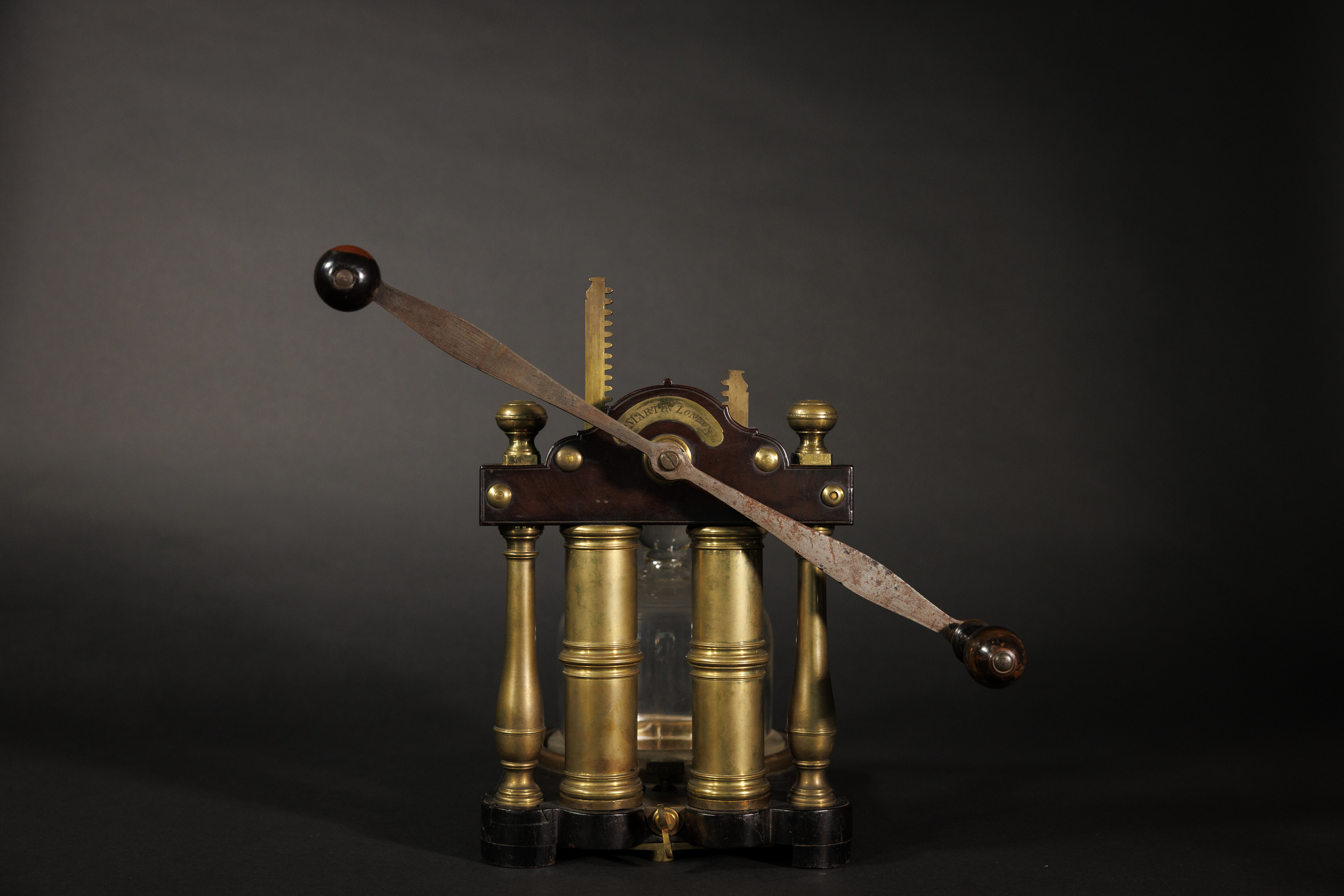
An air pump from the year 1770 is among the historical items featured in a new exhibit at the Collection of Historical Scientific Instruments. Curated by Emma Mendoza Broder, Ph.D. ’25, the display highlights 18th-century technology that fueled early America and is supported by the Richard Lounsbery Foundation and Revolution250.
Harvard College, established in 1636, has a long history of teaching applied sciences and has collected numerous tools over the years for subjects like physics and trigonometry. Some of these tools were even instrumental in the success of the Continental Army during the Revolutionary War.
Included in the exhibit is a London-made octant from 1786, used by Samuel Williams to determine the New York-Massachusetts boundary, and 18th-century sectors from London and Paris for mathematical calculations. A surveyor’s Y-level, possibly used during the Siege of Boston, is also on display.
In June 1775, Harvard students were sent home to accommodate Minutemen and other Colonial forces. Massachusetts Hall housed over 600 soldiers, while Holden Chapel held around 160. The Continental Army used Harvard’s building hardware to make bullets, according to Joyce Chaplin, a professor of Early American History.
Exhibit highlights include a hydraulic siphon from 1750-1770, a double-barreled air pump from 1770, and an orrery modeling celestial movements. Faculty used these instruments to demonstrate scientific concepts. A collection of items tied to Benjamin Franklin, including a brass conductor and a Thunder House model, showcases his contributions to science and safety.
The exhibition will remain open through 2026, providing visitors a glimpse into the technological advancements of Revolutionary America.
Original Source: news.harvard.edu