








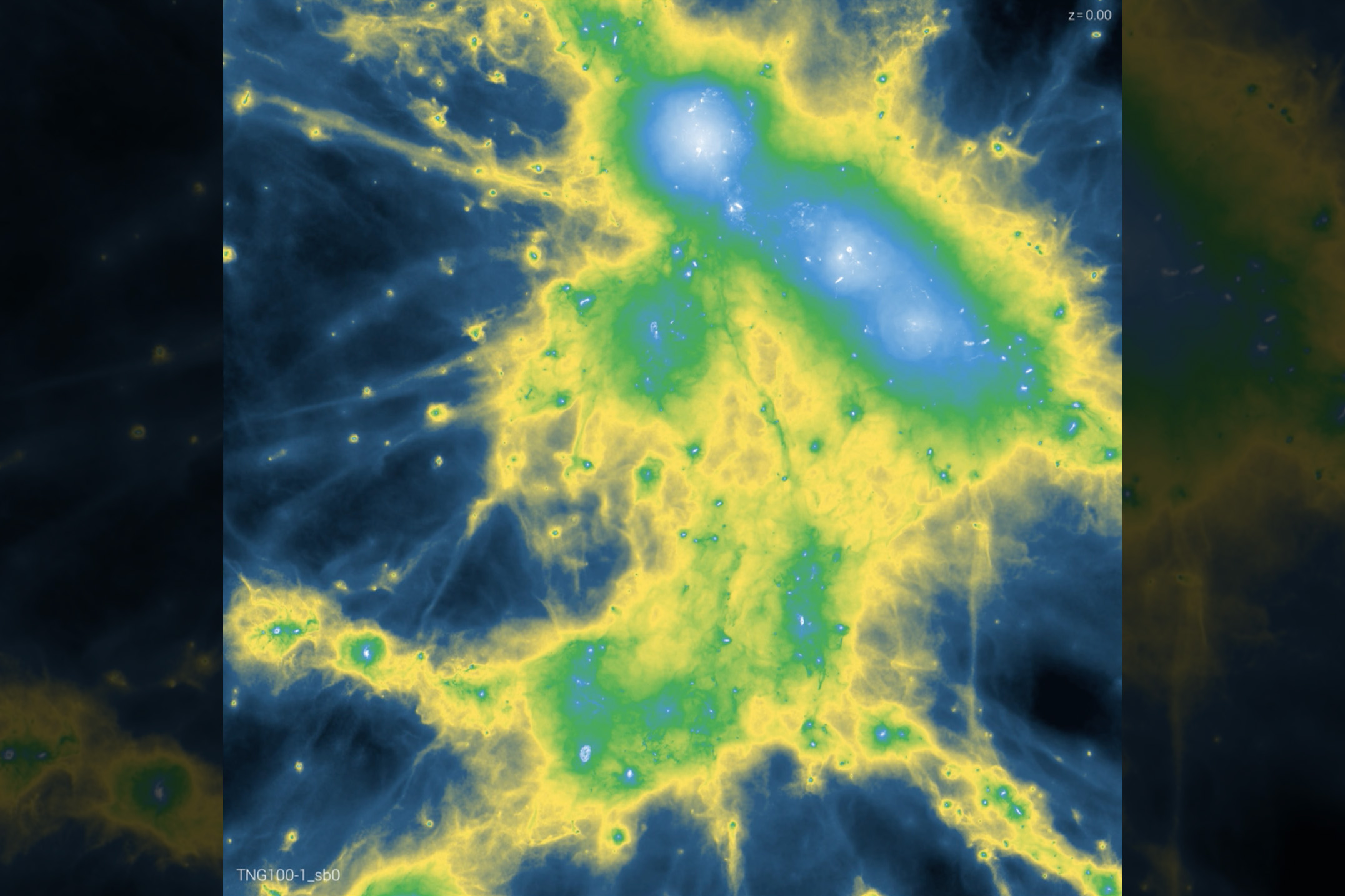
Stars and galaxies account for much of the universe’s visible matter, yet scientists have long puzzled over a discrepancy: there appears to be more matter than what is observed. Physicists estimate that shortly after the Big Bang, about 83% of the universe’s matter was dark matter, with the rest being ordinary matter. However, the quantity of ordinary matter in stars and galaxies today doesn’t match these estimates. This raises the question of where the missing matter has gone.
MIT researchers, part of the CHIME/FRB Collaboration, are now using distant radio signals to uncover this elusive matter between galaxies. They have devised a method that combines galaxy locations with fast radio burst (FRB) detections to identify missing matter. An FRB is a bright, brief flash of radio waves from energetic events in the distant universe. As the signal travels, it gets “smeared” by the matter it passes through, providing clues about the presence of missing matter.
The MIT-led team examined the smearing of thousands of FRB signals detected on Earth, comparing each with galaxy locations to determine the contribution of galaxy matter versus missing matter. The method revealed both the presence and location of missing matter, primarily in diffuse clouds around galaxy clusters, extending much farther than previously thought.
“We find that, overall, where there are more galaxies, there tends to be more missing matter around them,” said Haochen Wang from MIT’s Kavli Institute for Astrophysics and Space Research. The findings, published in Physical Review Letters, suggest that matter is expelled from galaxies by processes like black hole jets and exploding stars, which may be more powerful than anticipated.
“We’re finding missing matter that is pushed out to larger scales,” said Kiyoshi Masui, an MIT associate professor of physics. “These measurements indicate that star activity, and activity from black holes, is stronger and much more violent than predicted.” The study, co-authored by Shion Andrew, Adam Lanman, Kenzie Nimmo, and Ryan Raikman, along with other CHIME/FRB Collaboration members, explores the shape of matter in the universe.
The universe’s observable matter is largely composed of baryons, subatomic particles making up most of an atom’s mass. After the Big Bang, only 17% of the universe’s matter was baryonic. This early matter formed everything we see today, but its total mass is only a fraction of what existed initially, suggesting additional matter exists between galaxies, albeit at low densities.
Recent findings have shown that missing matter can be detected using fast radio bursts. Discovered in 2007, FRBs are ultrashort signals from distant galaxies. “What makes FRBs good to probe missing matter is that they have a special property,” Wang explained. “They start out as a very quick flash, and as they pass through matter, they smear out in time. And we can measure that smearing very precisely.”
Previous studies confirmed tenuous clouds between galaxies, but Masui and Wang aimed to map the shape of this missing matter. “We’re not just probing if the gas is with the galaxy or not, but we are seeing the shape of the missing matter that’s around the galaxies,” Wang noted. This mapping helps understand galaxy formation and interaction with their surroundings.
In their study, the team mapped missing matter around galaxies by cross-referencing FRB measurements with galaxy locations. They used data from the Canadian Hydrogen Intensity Mapping Experiment (CHIME) and the Dark Energy Spectroscopic Instrument (DESI) survey. CHIME, located in British Columbia, scans the northern sky for radio waves and has detected around 4,000 FRBs. DESI, mounted on the Mayall Telescope in Arizona, measures light from millions of galaxies to estimate dark energy.
From CHIME’s data, the team analyzed 2,870 FRB signals, measuring the smearing of various wavelengths. They correlated these measurements with DESI’s galaxy data to identify links between missing matter and galaxies. The analysis showed that missing baryonic matter is found around galaxy clusters, scattered over large areas instead of being densely packed.
“A galaxy is maybe a few 100,000 light years across, and we found missing matter out to about 4 million light years,” Masui said. “That’s further than the simulations predict.” Wang added, “We are finding that the activity in galaxies is messier than we thought. They’re more like fountains, and really push out gas to very large distances.”
The results demonstrate that fast radio bursts are a reliable tool for locating missing matter. As CHIME continues to detect more FRBs, the team expects their method to improve. “We got it to work for the first time, and will get it to work even more precisely as data gets better,” Masui stated.
Original Source: news.mit.edu