









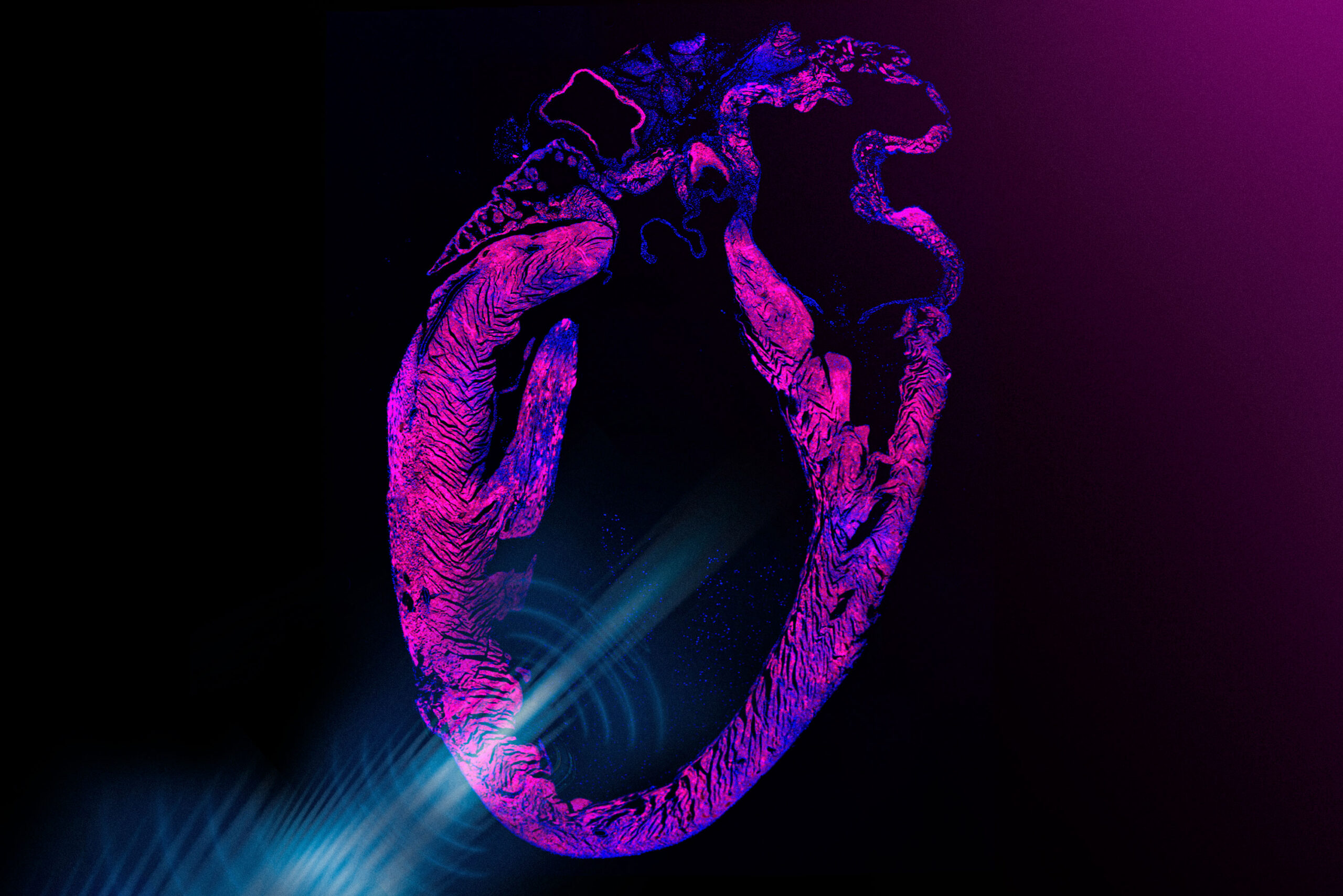
Engineers at MIT have created a pacemaker that uses ultrasound to stimulate the heart without surgery. This innovation may eventually serve as a non-surgical alternative to traditional cardiac implants. The small device is a sticker worn on the chest, featuring tiny transducers that emit ultrasound pulses to activate the heart.
The ultrasound waves open specific ion channels in heart cells, a response enhanced by genetic engineering. As these channels open, calcium enters, prompting heart cells to contract and beat. Laboratory experiments showed that ultrasound maintained healthy contractions in engineered human cardiac cells. Tests on rats demonstrated the device could quickly and safely correct arrhythmias and restore normal heartbeats.
A prototype has been developed, consisting of the ultrasound sticker, about the size of a postage stamp, and a compact device with batteries and electronics. The same team had previously designed a sticker to image deep organs using ultrasound. Now, they aim to integrate imaging and regulation of the heart’s activity into one sticker.
“We believe you could one day have stickers on the body that could do long-term imaging deep in the body and also do stimulation for therapeutic effects, in a noninvasive closed-loop way,” states Xuanhe Zhao, an MIT mechanical engineering professor.
Collaborating with Professor Qifa Zhou’s group at the University of Southern California (USC), Zhao and his colleagues have published their findings in Nature Biomedical Engineering. The MIT team includes first author Chen Gong, with Runze Li, Won Jun Song, and former postdocs Gengxi Lu, Shucong Li, and Hsiao-Chuan Liu.
Currently, around 3 million Americans rely on surgically implanted pacemakers to maintain heart rhythm. Despite their effectiveness, these devices come with risks. “Pacemakers are one of the most important and widely used human implants, and they have saved millions of lives,” notes co-corresponding author Gengxi Lu. “But they are invasive, and they make direct contact with the beating heart.”
Ultrasound, a type of acoustic wave, safely penetrates the body and can image internal structures. It can also be focused for therapeutic effects, such as treating neurological diseases. Previous studies showed ultrasound could activate heart cells in animals, but the effects were inconsistent.
Zhao’s team aimed to enhance ultrasound’s impact on the heart using sonogenetics, a method similar to optogenetics, which involves genetically modifying cells to respond to light. Sonogenetics modifies cells to react to sound. In the lab, they increased heart cells’ ultrasound sensitivity by genetically altering them to produce ion channels that open more easily.
“These channels can now ‘hear’ ultrasound better, and can open to let calcium in, which is what directly activates the cell and causes it to beat,” explains first author Chen Gong.
Tests with these engineered heart cells showed they beat synchronously with ultrasound waves, unlike unaltered cells. The team envisions a clinical application where patients receive a gene therapy injection to increase cardiac cells’ sensitivity to ultrasound.
Gong suggests, “We think this step would be clinically translatable as a form of gene therapy that could enable noninvasive pacemakers.”
The core of the ultrasound pacemaker is a sticker with tiny transducers, made from a hydrogel that adheres strongly while allowing ultrasound transmission. The transducers can be adjusted to specific frequencies. Experiments on rats involved administering a sonogenetic solution and attaching the pacemaker sticker to their chests. The ultrasound quickly normalized their heart rates.
Gong notes, “We can now use low-intensity ultrasound to open ion channels in cells to have very effective heart pacing.” Efforts are underway to make the stickers smaller, more integrated, and easier to wear.
“In this paper, we demonstrated noninvasive pacemaking. However, we think this concept could be useful beyond just the heart,” Zhao adds. “We believe you could one day have stickers over different parts of the body that could do long-term imaging, monitoring, and closed-loop therapeutic stimulation.”
Original Source: news.mit.edu