





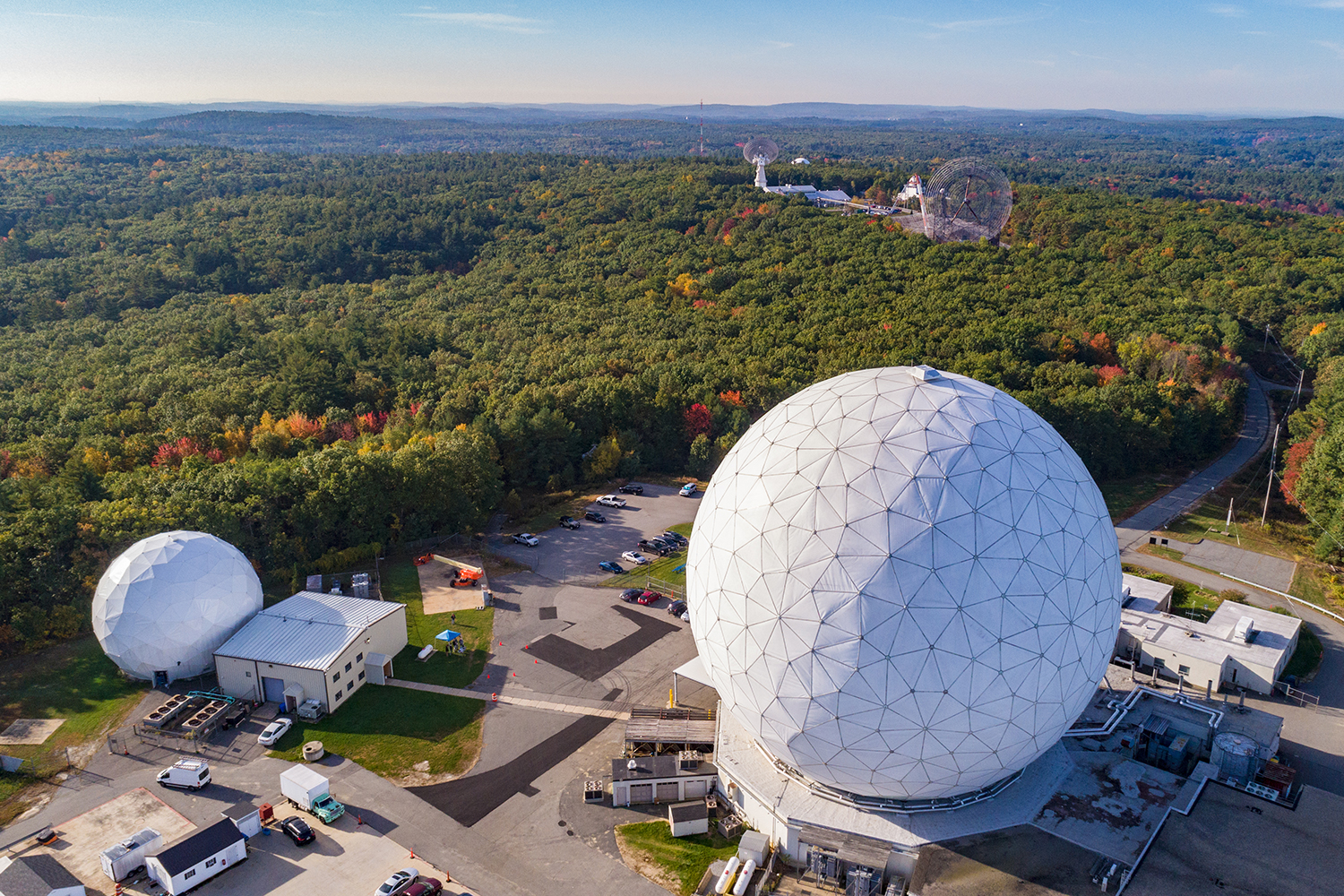
The Haystack 37m Telescope, a significant tool in radio astronomy and solar system radar studies since 1964, has played a crucial role in various scientific achievements, including aiding NASA’s Apollo missions, mapping Venus, testing Einstein’s theories, and pioneering VLBI developments. Recently, after extensive upgrades, it has resumed its role in cutting-edge astronomical research at MIT Haystack Observatory in Westford, Massachusetts.
On December 8, 2025, researchers utilized the telescope to study the supermassive black hole system at Messier 87 (M87) using very long baseline interferometry (VLBI), a technique that connects telescopes across the globe for high-resolution observations. This marks a return to its historic scientific mission.
The observations focused on the energy and matter jet emanating from M87’s central black hole, M87*, which is six-and-a-half billion times the sun’s mass. This jet stretches thousands of light years into space, representing one of the universe’s most powerful phenomena. Collaborating with the Very Long Baseline Array (VLBA) and Greenland Telescope (GLT), the Haystack 37m Telescope contributes to understanding how energy travels beyond the black hole’s vicinity, a key question in galaxy formation.
Paul Tiede, the principal investigator, highlights the telescope’s sensitivity in detecting faint emissions from M87*. Working with the GLT and VLBA, Haystack is developing multifrequency movies of the black hole’s jet, enhancing black hole physics comprehension.
The revitalized Haystack 37m Telescope opens new research avenues. At MIT, scientists like Saverio Cambioni and Richard Teague plan to use it to measure asteroid sizes for the Planetary Defense Project, while Brett McGuire aims to search for complex molecules in space, exploring life’s chemical origins.
Jens Kauffmann, leading the Haystack 37m Telescope Astronomy Program, emphasizes the telescope’s value as a rare educational tool, providing hands-on training for future astronomers. Student involvement has resumed, with interns contributing to control systems and data analysis development at the observatory.
The telescope’s return to research followed over a decade of upgrades. From 2010 to 2014, enhancements improved its millimeter wavelength observation capabilities, initially for U.S. government space radar needs. The National Science Foundation (NSF) and private donors supported ongoing upgrades, with significant advances made by 2025.
Support from MIT’s Jarve Seed Fund and projects led by the Smithsonian Astrophysical Observatory helped remove technical barriers, enabling the December 2025 M87 observations. MIT Haystack Observatory seeks further funding to enhance the telescope under the Haystack 37m Telescope Astronomy Program.
Richard Teague from MIT EAPS points out that the telescope allows researchers to tackle fundamental questions about our origins and the solar system. With its capabilities, ambitious observational projects are now feasible, launching a promising era of discoveries with the Haystack 37m Telescope.
Original Source: news.mit.edu