





In 1985, the Innovative Design Fund advertised in Scientific American, offering up to $10,000 for innovative prototypes in clothing, home decor, and textiles. William Freeman, who was an electrical engineer at Polaroid and is now an MIT professor, submitted a unique idea: a three-sided zipper. Unlike traditional zippers for clothing, this was envisioned to switch items like chairs, tents, and purses between soft and rigid states, enhancing portability and assembly. Freeman’s design, resembling a typical zipper but triangular, used belts to link narrow wooden “teeth.” A slider would fasten the strips into a triangular tube. Although his idea was not accepted, Freeman patented it and stored the prototype, hoping for future use.
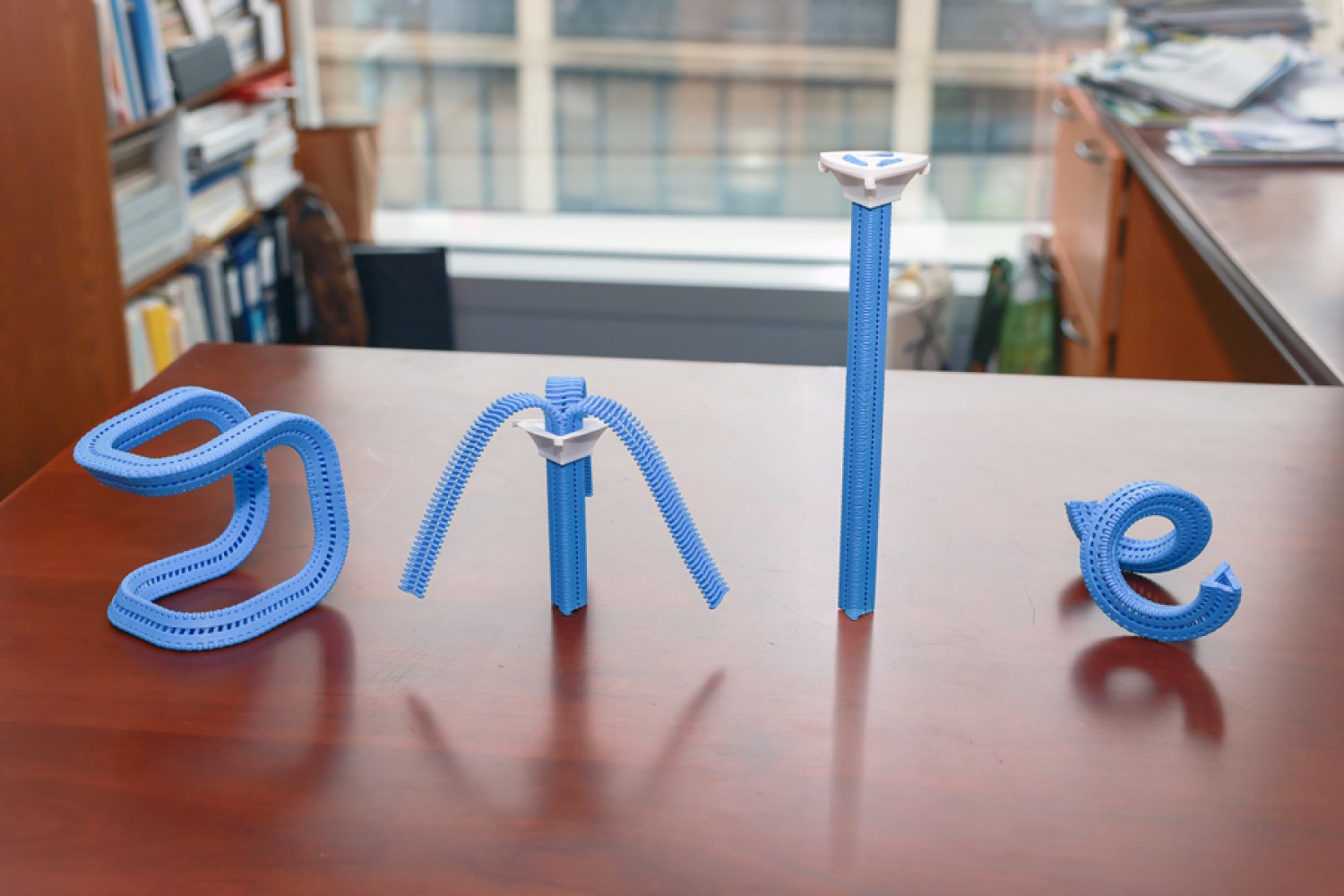
Nearly four decades later, MIT’s Computer Science and Artificial Intelligence Laboratory (CSAIL) decided to revisit Freeman’s concept to develop items with adjustable stiffness. Past methods for this weren’t easily reversible or needed manual assembly. CSAIL created an automated tool and adaptable fastener known as the “Y-zipper.” Their software allows users to design customized three-sided zippers, which are then 3D printed using plastic. These can be incorporated into camping gear, medical devices, robots, and art installations for easier assembly. MIT postdoc and CSAIL researcher Jiaji Li, a lead author on the project, stated, “We’ve developed a process that builds objects you can rapidly shift from flexible to rigid, and you can be confident they’ll work in the real world.”
The CSAIL software lets users customize fastener designs, choosing strip lengths and bending angles. Four motion options are available: straight, bent like an arch, coiled like a spring, or twisted like screws. The resulting Y-zipper can change shapes, appearing like a squid with tentacles when open and forming a compact structure when closed. This adaptability is advantageous for tasks such as pitching a tent, which can be accomplished much quicker with the Y-zipper’s help. The system also promises benefits for medical wearables, allowing adjustments for comfort and functionality.
The Y-zipper system can also facilitate technology that operates at the push of a button. A motor can be added to automate the zipping, useful for creating adaptable robots, such as one that changes leg length to navigate various terrains. The Y-zipper’s potential extends to dynamic art installations, like a flower that “blooms” through motorized zipping.
To test the Y-zipper’s durability, the team conducted stress tests using PLA and TPU plastics. The tests showed PLA’s strength under heavy loads and TPU’s flexibility. In endurance tests, the Y-zipper withstood 18,000 cycles of zipping and unzipping before breaking. Its durability is attributed to its elastic structure, which evenly distributes stress.
Despite these results, Li hopes to create even more robust zippers with stronger materials like metal. Larger zippers for bigger projects are also a possibility, though current 3D printing technology limits this. Li sees potential applications such as space exploration, where Y-zippers could help collect rock samples, and in rapid assembly of emergency shelters during crises.
Zhejiang University assistant professor Guanyun Wang, not involved in the research, praised the project: “Reimagining an everyday zipper to tackle 3D morphological transitions is a brilliant approach to dynamic assembly.” The work of Li, Freeman, and their team, including contributions from multiple universities, was presented at the ACM’s Computer-Human Interaction (CHI) conference in April.
Original Source: news.mit.edu