





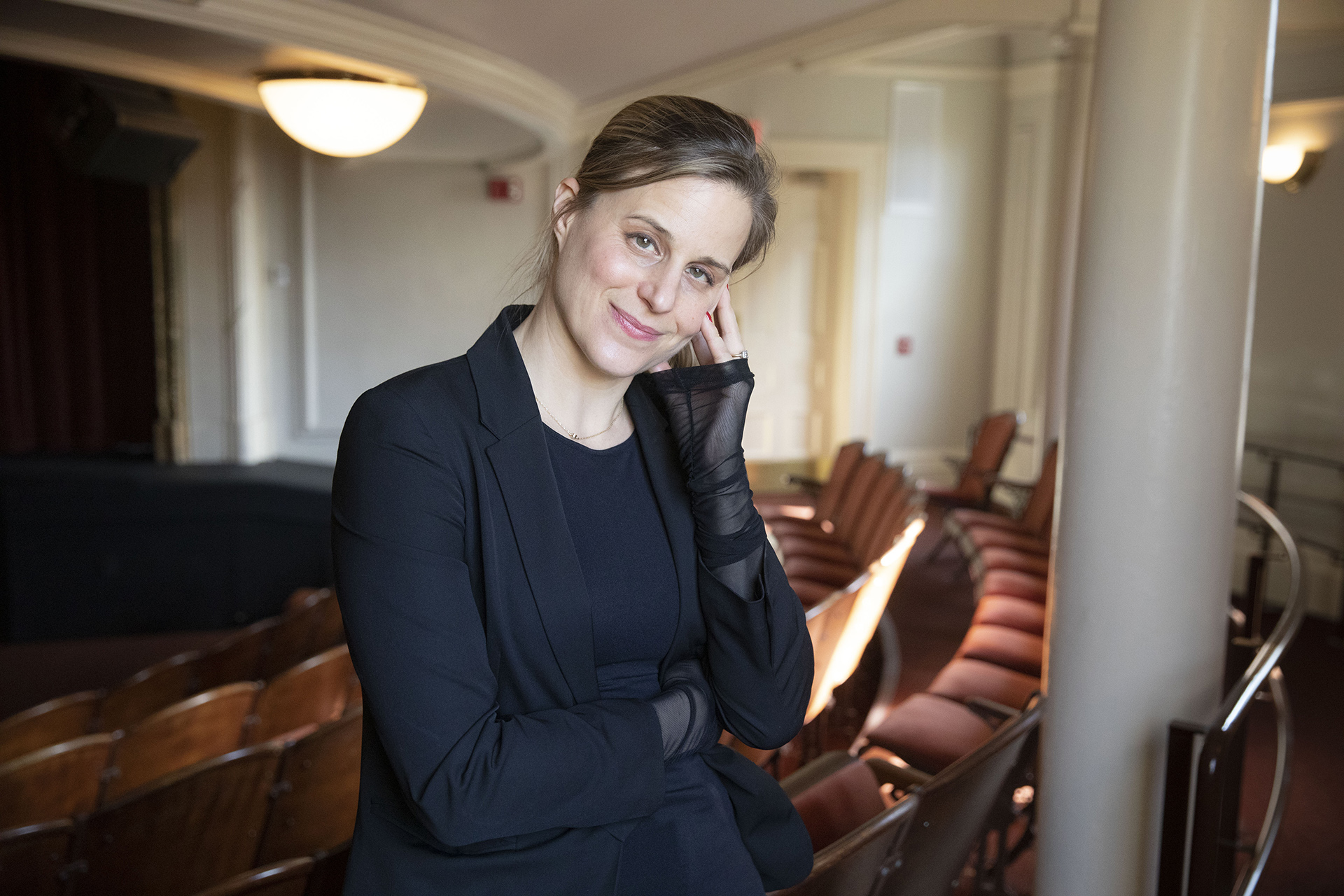
During a recent talk at the Harvard Radcliffe Institute, author Lauren Groff surprised her interviewer by confessing that she writes and publishes poetry under a pseudonym. Responding to a question from fellow author Gish Jen, who moderated the first Virtual Radcliffe Book Talks session, Groff laughed and said, “I do write poetry and I publish it, but not under my name.” Jen, a 2002 Radcliffe fellow, expressed her amazement, saying, “Whoa. Oh my goodness. This has not come out before. An alias … fascinating.”
Groff, known for her novels like “Monsters of Templeton” and “Fates and Furies,” as well as short story collections such as “Delicate Edible Birds,” has been a three-time finalist for the National Book Award. In past discussions, she has credited Emily Dickinson for inspiring her to become a writer. At the talk, she mentioned starting her mornings with poetry as “a jolt of literary caffeine.” Despite her revelation, Groff did not reveal her pen name, nor did Jen press her for it.
Groff explained her attraction to poetry, noting, “Poets can do things that I think prose has a really hard time doing.” She highlighted the ability of poems to employ a non-obvious speaker and the necessary compression within poetry that differs from novels or short stories. Among her favorite poets are Terrance Hayes, Natalie Diaz, Ada Limon, Walt Whitman, and Dickinson. She also commended the 2025 poetry collection “Lazarus Species” by Devon Walker-Figueroa.
The discussion also covered Groff’s writing process and her latest short story collection, “Brawler: Stories.” These stories delve into themes of love, fear, and violence, inspired by the culture of violence in North American societies. Groff revealed she prefers juggling multiple projects simultaneously, saying, “If I obsess too much about one thing, that thing will never get done.” She co-owns The Lynx Books in Gainesville, Florida, with her husband.
Groff discussed her lengthy writing process, noting that some books take years to develop. She likened her stories to “living entities” that need time to mature. “One has to allow them to grow and to come to you with the amount of time it takes for them to grow,” she explained. Groff emphasized the importance of patience, suggesting that sometimes the right time or form for a story has yet to be found.
An Amherst College graduate with an M.F.A. from the University of Wisconsin-Madison, Groff reflected on her transformative experience at Radcliffe. There, she conceived “Matrix,” a historical novel about medieval writer Marie de France, marking the first in a series followed by “The Vaster Wilds.” Looking ahead, Groff plans to explore themes of religion in her future work, intrigued by how religions depict human struggles with the incomprehensible. “I’ll never stop wrestling with God,” she remarked about her ongoing literary exploration.
Original Source: news.harvard.edu