





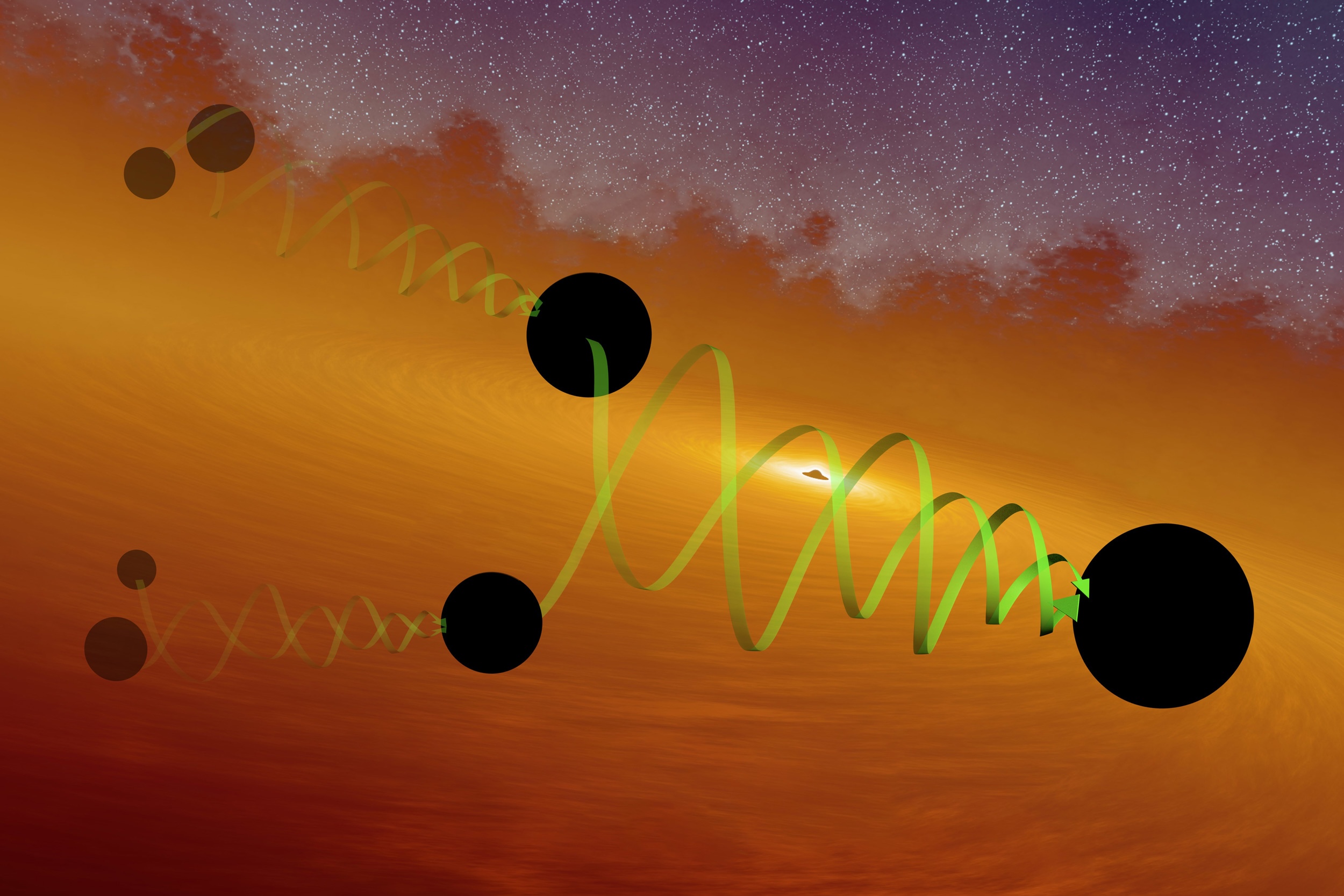
Traditionally, black holes have been understood to form from the remnants of dying stars. As a massive star reaches the end of its life, it explodes in a supernova, leaving behind a dense core that becomes a black hole. However, recent findings from gravitational-wave detectors suggest that some black holes may not originate from stars alone. These black holes might arise from the merger of smaller black holes, a process known as “hierarchical merging.”
Researchers at MIT have analyzed data from the LIGO, Virgo, and KAGRA observatories, which includes 155 binary black hole pairs. Their study indicates that approximately 14% of these merging black holes are second-generation, formed from previous black hole mergers. This discovery, published in Physical Review Letters, highlights the importance of hierarchical merging in black hole formation. “It’s not their first rodeo,” says Cailin Plunkett, a graduate student and the study’s lead author, noting the frequency of these events in the universe.
Plunkett, along with colleagues Salvatore Vitale, Thomas Callister, and Michael Zevin, focused on the spin of black holes. A massive star’s collapse typically results in a black hole with minimal spin due to the loss of angular momentum during the supernova. In contrast, second-generation black holes, formed from mergers, tend to spin rapidly. “They would be spinning very fast, at about 70 percent their maximum possible spin,” says Vitale.
Hierarchical mergers are thought to occur in densely packed stellar environments where stars can become black holes and subsequently merge. This repeated merging creates black holes with high spin and mass, deviating from what is expected from star-born black holes. In 2024, two lopsided black hole mergers were detected, suggesting that one black hole in each pair had previously resulted from a merger, as evidenced by its high spin.
The team analyzed the LIGO-Virgo-KAGRA Gravitational Wave Transient Catalog 4.0, looking for patterns indicative of hierarchical mergers. They identified a characteristic pattern of “wobbles” in the orbital plane of merging black holes, revealing that some mergers involved first- and second-generation black holes. Approximately 14% of black holes were found to have merged before, with second-generation black holes often having masses around 20 or 40 solar masses.
The presence of black holes with masses above 40 solar masses challenges existing theories of stellar evolution, which suggest that supernovae from massive stars should not leave behind black holes in this range. The team’s findings support the theory that such massive black holes may result from repeated black hole mergers, offering a new perspective on their origins. This research received support from the National Science Foundation and the Brinson Foundation.
Original Source: news.mit.edu