







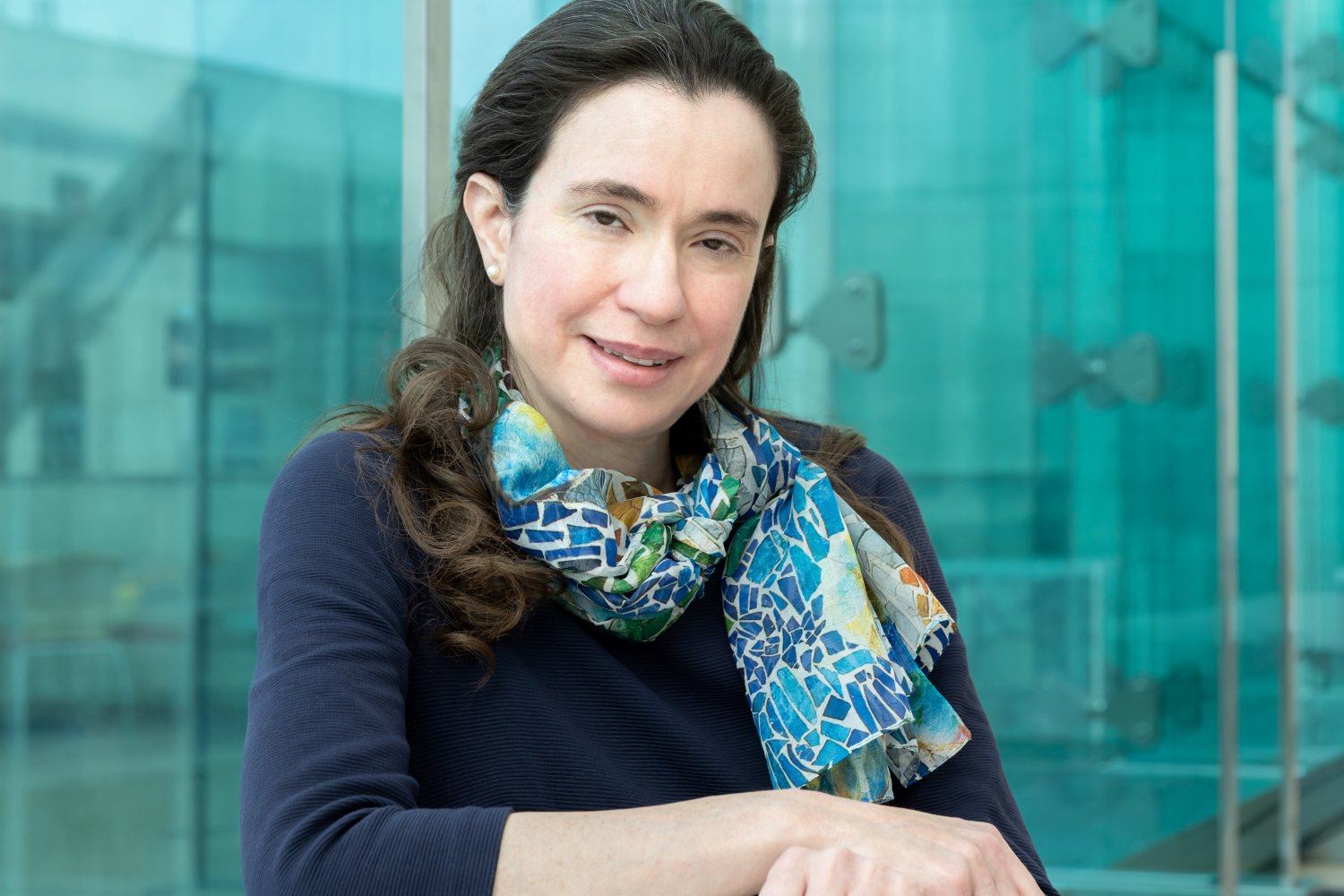
Myriam Heiman, currently the John and Dorothy Wilson Professor of Neuroscience at MIT, will take over as director of the Picower Institute for Learning and Memory at MIT, starting July 1. She follows Picower Professor Li-Huei Tsai, who is resigning after 16 years in the role.
Heiman, a molecular neurobiologist and geneticist, investigates neurodegenerative diseases affecting the brain’s basal ganglia, such as Huntington’s and Parkinson’s diseases. Employing advanced techniques like single-cell genomics and a transcriptomic method she co-developed, translating ribosome affinity purification, she seeks to uncover the molecular alterations that lead to cell death in these disorders.
“Myriam is an exceptional scientist and a proven leader at MIT, as well as a caring and generous mentor,” states Nergis Mavalvala, dean of the MIT School of Science and Curtis and Kathleen Marble Professor of Astrophysics. “Her research on why certain brain cell types are vulnerable to diseases like Huntington’s has been profound and wide-ranging. I am confident she will excel in leading the Picower Institute into its next phase.”
“I am privileged to take on this position to aid the institute’s outstanding scientists and trainees as they pursue discoveries to enhance our understanding of the brain and improve human health,” says Heiman, who is also a professor in MIT’s Department of Brain and Cognitive Sciences (BCS).
The Picower Institute comprises 16 neuroscience laboratories focused on deciphering the mechanisms underlying learning, memory, and related functions like cognition, emotion, perception, behavior, and consciousness. Researchers at the institute examine the brain and nervous system at various levels, from genes and molecules to cells and synapses, to circuits and systems, generating insights into how disruptions can lead to developmental, psychiatric, or neurodegenerative diseases.
Founded by Picower Professor Susumu Tonegawa in 1994, the institute became a full-fledged institute in 2002 thanks to a significant donation from Barbara and Jeffry Picower. Li-Huei Tsai, director since 2009, announced in March her decision to step down after over 16 years to concentrate on her research.
Heiman joined the Picower Institute, BCS, and the Broad Institute of Harvard and MIT in 2011, after completing postdoctoral work at The Rockefeller University. She earned her PhD from Johns Hopkins University and a BA from Princeton University.
“Since joining the institute, Heiman’s research has been driven by the belief that fundamental understanding can lead to breakthroughs in disease treatment,” Tsai remarks. “Myriam has dedicated herself to tackling pressing questions in neuroscience.”
Heiman uses sophisticated DNA and RNA analysis to study the changes in brain cell states during disease, uncovering molecular pathways that explain why certain cell types are more susceptible. In 2020, she published findings from a novel in vivo screening of every mouse gene’s effect on neuron survival, identifying hundreds of genes critical for neuron sustenance and highlighting a specific gene that enhances resilience in Huntington’s disease.
Further studies, including those on mice and human brain samples postmortem, have uncovered faulty immune responses in neurons and brain blood vessels contributing to disease progression. A 2022 paper, co-authored with MIT colleague Manolis Kellis, provided one of the first cellular maps of the brain’s vasculature.
Her research has also offered insights into other neurodegenerative and psychiatric disorders, such as ALS and frontotemporal dementia. In 2024, along with Kellis, Heiman published a study in Cell revealing significant cellular and molecular similarities between these diseases, pointing to potential therapeutic targets. Her recent work explores substance use disorders and schizophrenia.
Heiman’s research has earned numerous accolades. In 2021, she was co-awarded a National Institutes of Health Transformative Research Award, which supports interdisciplinary approaches that challenge existing paradigms. The following year, she secured a prestigious NIH R35 grant to identify early triggers of disease progression.
Heiman is also a devoted educator and mentor. She received the Department of BCS award for excellence in graduate mentoring in 2017 and the award for excellence in undergraduate teaching in 2020. In 2024, she was recognized as one of 23 MIT faculty members for their commitment to caring, an accolade from MIT’s Office of Graduate Education honoring exceptional mentorship.
Outside MIT, Heiman is on several editorial boards and the scientific advisory board of the Huntington’s Disease Foundation, which funds research for treatments and a cure for Huntington’s and related disorders.
Heiman expresses enthusiasm about her new leadership role at the Picower Institute. “I approach this role with humility and great enthusiasm,” she says. “The Picower Institute has a remarkable legacy, and I am eager to support the next generation of transformative research.”
Original Source: news.mit.edu