









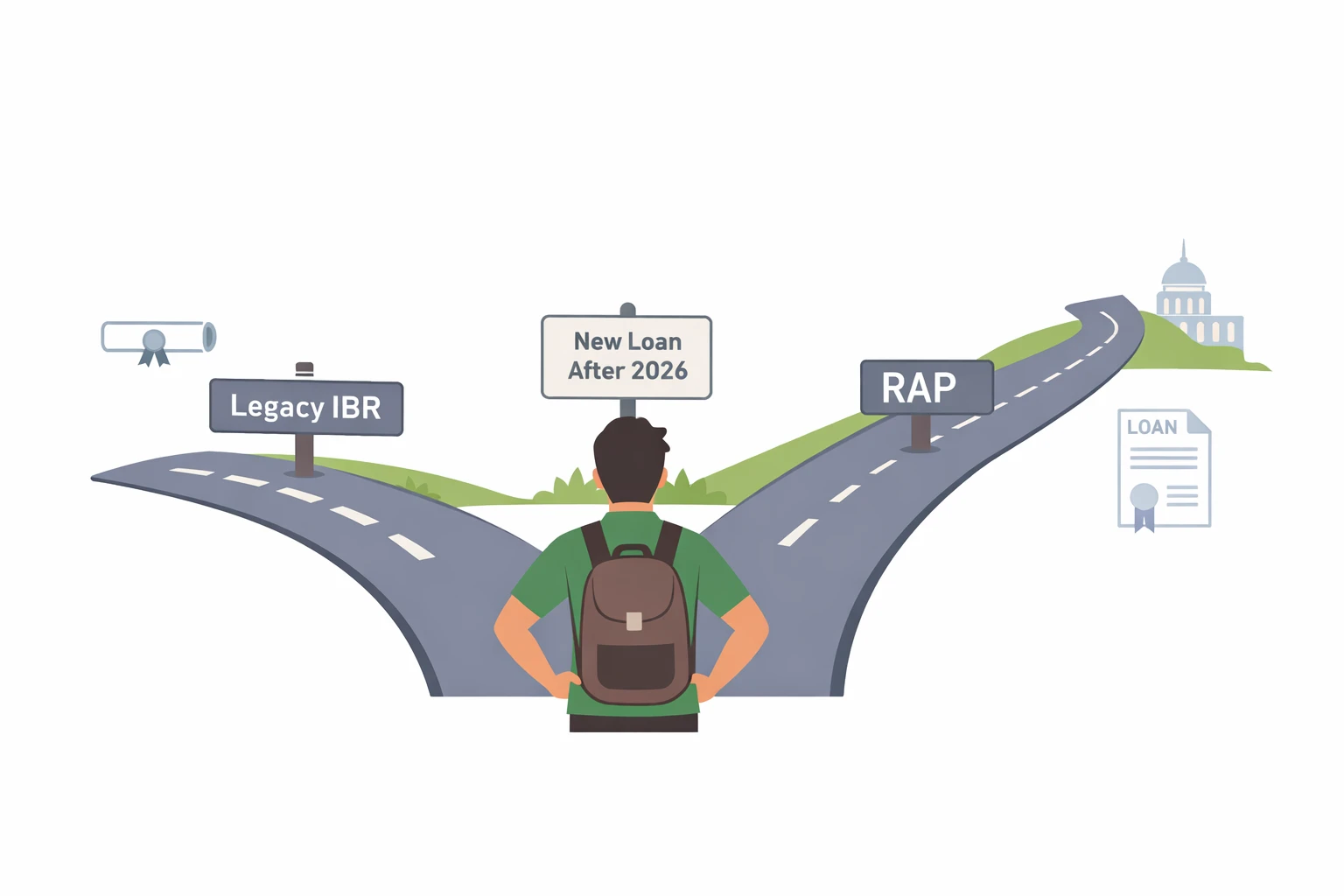
Borrowers with substantial federal student loans considering additional borrowing after July 1, 2026, should be aware of the new RAP rules in the One Big Beautiful Bill Act (OBBBA), which could alter repayment strategies. This article examines the “poison pill” effect, focusing on the mechanics rather than political aspects. This information is particularly relevant for borrowers with large pre-2026 federal balances exceeding $200k, high earning potential after training, and a need for further federal borrowing post-July 1, 2026.
The Repayment Assistance Plan (RAP) serves as a safety net for most, but for some high-debt professionals, repayment choices can significantly impact lifetime costs. This isn’t just about new loans; it involves the potential loss of New IBR protections and an extended repayment timeline. Eligibility for the OBBBA Legacy Provision is crucial, allowing some to continue borrowing under previous rules if they had loans disbursed before July 1, 2026, and remain in the same degree program.
Post-July 1, 2026, starting a new program disqualifies borrowers from the legacy exception, leading to capped or unavailable federal borrowing. The scenario may not apply if new programs or fellowships are pursued. For detailed insights into borrowing caps, particularly for medical and professional students, refer to the Medical School Loans Guide.
The “Poison Pill” is often misunderstood. Borrowing a federal loan after July 1, 2026, does not automatically place older loans on RAP. There are two triggers: consolidation of pre- and post-2026 loans into a Direct Consolidation Loan, which is irreversible, and plan alignment, where post-2026 loans restricted to RAP or Standard make it difficult to maintain separate plans long-term.
To maintain New IBR on older loans, the new loan must remain on a Standard plan. For example, if you have $350,000 in pre-2026 loans on New IBR and borrow $50,000 post-2026, keeping loans separate and the new loan on Federal Standard preserves New IBR on the larger balance. Conversely, placing the new loan on RAP or consolidating moves the entire balance to RAP.
New IBR and RAP caps differ. New IBR has a fixed dollar cap, often lower for high earners, while RAP payments are income-based, increasing as income rises. This difference significantly impacts long-term costs for high-income borrowers. RAP provides a 100% interest subsidy during low-income years, offering relief but resulting in higher costs long-term due to the extended timeline.
For high-debt professionals, consolidating $350k and $50k loans into a Direct Consolidation Loan results in RAP application for all, with a 30-year timeline and no payment cap. This option is best for those eligible for Public Service Loan Forgiveness (PSLF), as it offers interest subsidies during training. However, it extends repayment by 10 years compared to New IBR and increases long-term costs for non-PSLF borrowers.
Alternatively, keeping the $350k on New IBR and the $50k on a 10-Year Level Standard plan minimizes lifetime costs. This requires keeping loans separate and managing higher monthly payments. The $50k loan remains PSLF-eligible but would be repaid within 10 years, leaving nothing to forgive.
A potential pitfall with Option B is the servicer defaulting the $50k loan to a Tiered or extended Standard plan, which could accrue more interest and reduce cost advantages. Borrowers must actively manage to avoid this. Another option is taking the $50k as a private loan, leaving the $350k on New IBR, with private loan terms varying.
Original Source: studentloansherpa.com