


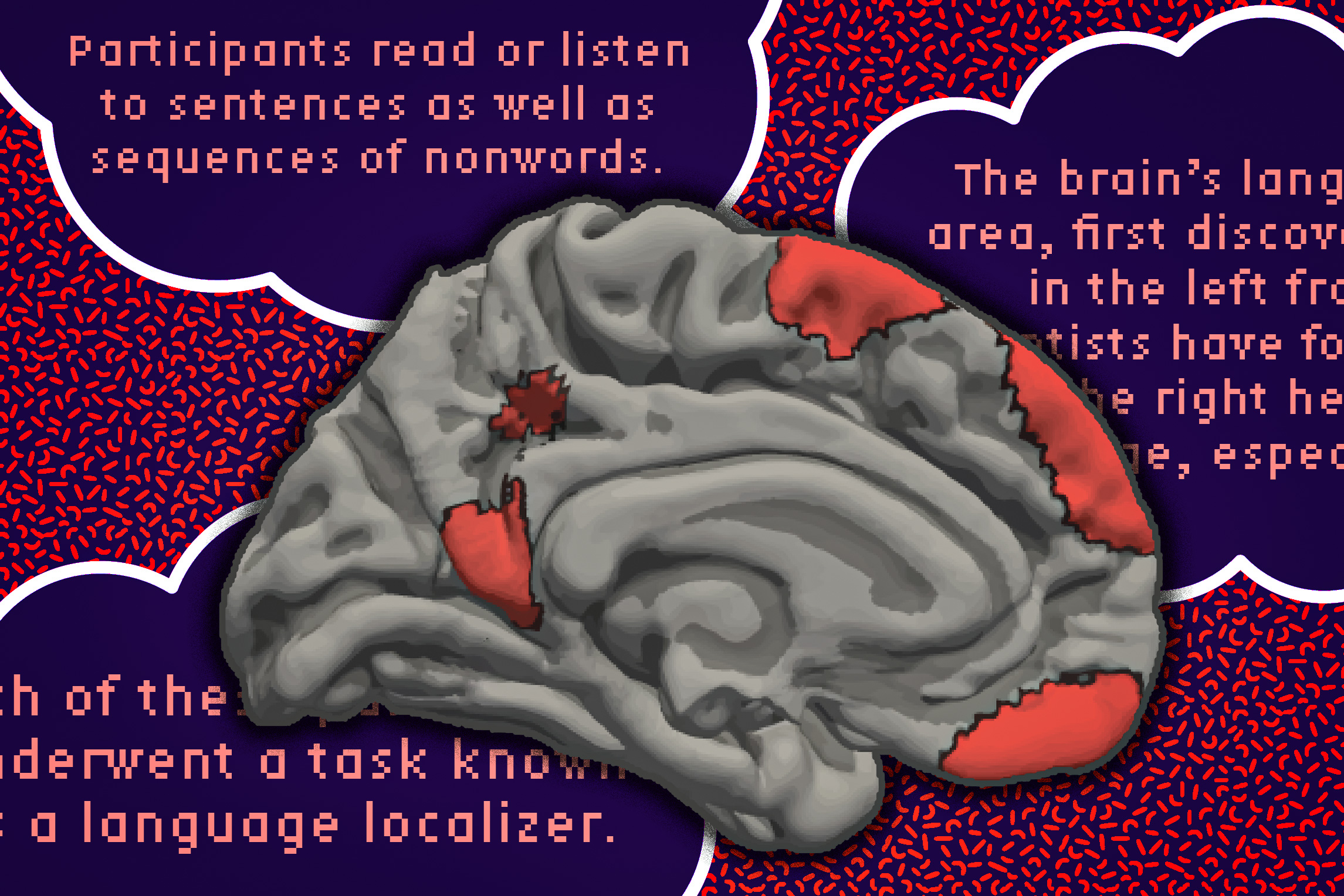
Neuroscientists have long recognized that language is processed in specific areas of the brain’s left hemisphere. However, recent findings from MIT researchers reveal that many other brain regions are also involved in language processing. By analyzing functional magnetic resonance imaging (fMRI) data from over 700 individuals, the researchers identified 17 additional brain regions linked to language. These areas, found in the cerebellum, hippocampus, and cerebral cortex, constitute about 5 percent of the adult brain’s volume, roughly the size of a large strawberry.
“Even though there are all these distant components, it’s pretty restricted in terms of volume. You don’t need that much of the brain to do language,” said Evelina Fedorenko, an MIT associate professor and senior author of the study. The exact role these regions play in language processing remains unclear, but the team is making progress in understanding the functions of the identified cerebellar regions.
Agata Wolna, an MIT postdoc, is the lead author of the paper published in the Journal of Neuroscience. The study also involved Aaron Wright, a K. Lisa Yang Post-Baccalaureate Research Scholar at MIT; Colton Casto, a Harvard University graduate student; Samuel Hutchinson, an MIT graduate student; and Benjamin Lipkin PhD ’26.
The brain’s known language processing centers include Broca’s area and other regions in the left frontal and temporal lobes. Some areas in the right hemisphere are also known to aid in processing language, particularly its social-emotional aspects. There have been indications that more parts of the brain might be involved in language.
Fedorenko’s earlier language research often highlighted active regions outside the traditional language centers. Despite resistance to including them in her papers, the new study revisits these brain scans to identify language regions beyond the standard areas. The researchers analyzed data from 772 participants scanned in Fedorenko’s lab since 2013, using a language localizer task to pinpoint language processing locations.
During this task, participants read or listen to sentences and nonwords, measuring brain response differences when processing real sentences versus nonsense sequences. Brain areas that respond more during sentence tasks are considered language-relevant, especially if they react while both reading and listening to sentences, according to Wolna.
By relaxing the statistical threshold and conducting targeted searches in subcortical areas, the team aimed to uncover all regions contributing to language processing. “We always see this frontal temporal network, but there’s quite a lot of evidence that there are other regions that are also critical for language processing,” Wolna noted.
For around 490 participants, the researchers also examined brain responses during a spatial working memory task, which activates the multiple demand system, distinct from core language areas. This allowed them to determine if the newly identified regions respond specifically to language rather than general cognitive processes.
The study found five new language sites in the cerebellum, which is primarily involved in movement coordination. Research led by Casto earlier this year showed that three of these cerebellar regions are also active during some nonlinguistic cognitive tasks, a finding corroborated by this study.
“Those areas that respond to both language and some other tasks could be really interesting and important because they may be doing something like integrating information from different cortical systems,” Fedorenko explained. The research also identified language-selective regions in the medial frontal cortex, the bottom surface of the left temporal lobe, the hippocampus, and the amygdala.
The team plans to further investigate how these brain regions contribute to language processing. “We can now test some ideas from past work, and also more rigorously characterize these regions across different kinds of language manipulations, and different kinds of nonlinguistic tasks, to try to understand what it is that they’re doing,” Fedorenko stated.
Original Source: news.mit.edu