





May 22, 2026 — Washington, D.C.
U.S. Citizenship and Immigration Services has announced a major policy shift stating that Adjustment of Status will generally be treated as an extraordinary form of relief rather than a routine pathway to a Green Card for temporary visa holders inside the United States.
Under the new USCIS policy memorandum, adjustment of status under INA Section 245 remains discretionary. USCIS officers are instructed to review each case individually and consider whether the applicant deserves a favorable exercise of discretion. The memo emphasizes that adjustment of status is considered “administrative grace” and is not intended to replace the ordinary immigrant visa process through U.S. consulates abroad.
According to USCIS, nonimmigrants such as students, temporary workers, and visitors generally enter the United States for a limited purpose and are expected to depart when that purpose ends. The agency stated that individuals seeking permanent residence should generally pursue immigrant visa processing through the Department of State outside the United States, unless their case involves circumstances strong enough to justify adjustment inside the country.
The memorandum directs officers to consider both positive and negative factors, including immigration history, compliance with visa conditions, family ties, moral character, fraud concerns, unauthorized employment, failure to maintain status, and whether the applicant’s conduct was consistent with the purpose of the original visa or parole. USCIS also states that when adjustment is denied as a matter of discretion, officers must provide a written explanation discussing the positive and negative factors considered.
The policy does not automatically eliminate all adjustment of status cases. The memo notes that officers must still conduct a case-by-case review, and it recognizes that some categories, including certain dual-intent nonimmigrant categories and specific immigrant pathways, may require different treatment. However, the overall message is clear: USCIS intends to apply greater scrutiny to adjustment requests when consular processing is available.
What This Means
This announcement may significantly affect applicants who are physically present in the United States and hoping to obtain permanent residence without leaving the country. Applicants with pending or future Form I-485 applications may face closer discretionary review, especially if they have gaps in status, unauthorized employment, visa violations, or other negative immigration history.
However, the policy does not say that every pending adjustment case will automatically be denied. Instead, USCIS says officers must evaluate the totality of the circumstances and decide whether the applicant qualifies for this extraordinary discretionary relief.
A later statement attributed to USCIS spokesman Zach Kahler suggests that the policy may not affect all applicants equally. Kahler said that while USCIS works to operationalize the new policy, applicants whose cases provide an economic benefit or are otherwise in the national interest will likely be able to continue processing their green card applications from inside the United States. Others, however, may be asked to complete the process abroad depending on their individual circumstances.
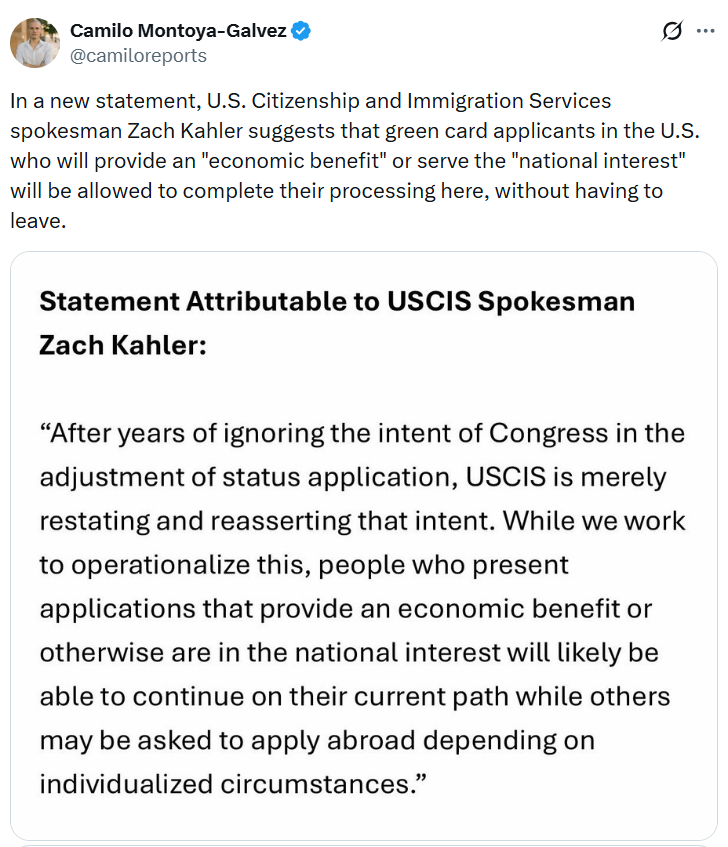
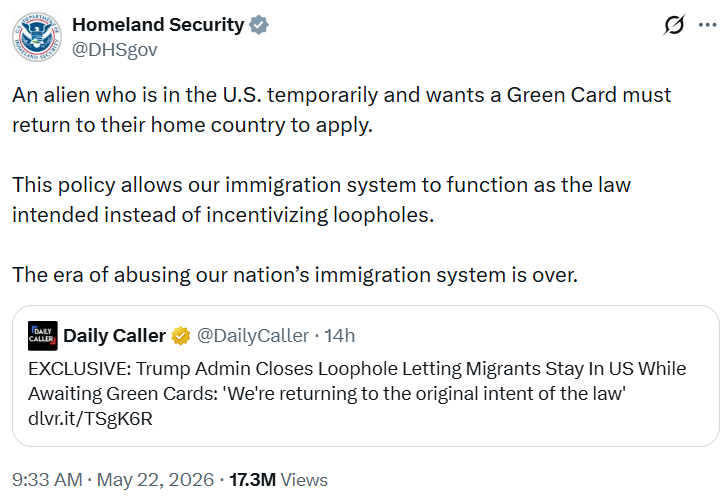
This clarification indicates that USCIS may apply the new policy with exceptions for certain applicants, especially those whose work, investment, research, employment, or other contributions can be viewed as beneficial to the U.S. economy or national interest. However, the agency has not yet clearly defined how it will determine which applicants meet that standard. Therefore, while the policy represents a major shift toward consular processing, it may still leave room for some employment-based, research-based, investment-based, or national-interest applicants to remain on their current adjustment pathway.
Disclaimer: This article is for general information only and does not constitute legal advice. Applicants with pending immigration cases should consult a qualified immigration attorney before making travel, filing, or status-related decisions.
For more information, see the policy memo to USCIS immigration officers.