





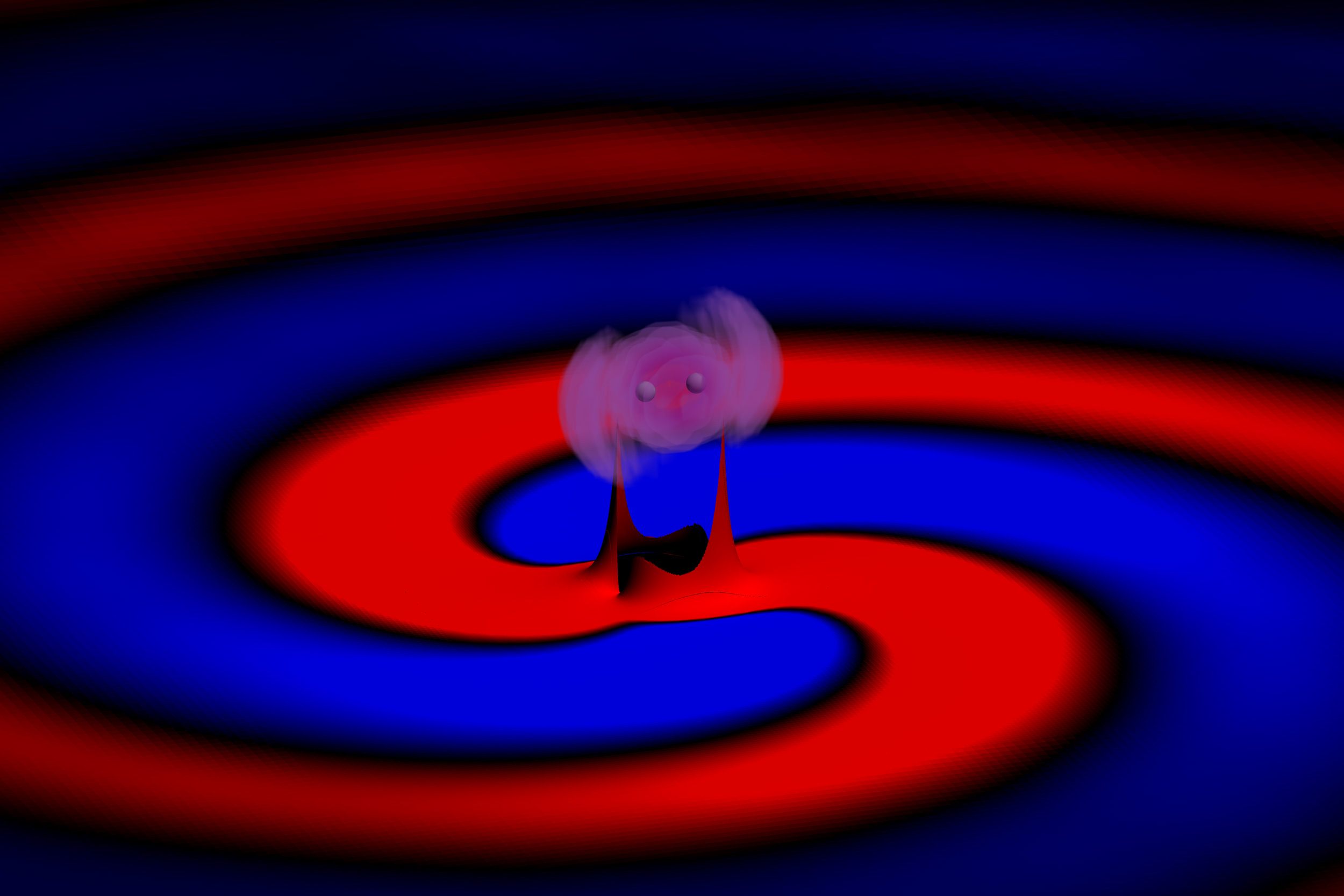
Dark matter is believed to constitute the majority of matter in the universe, interacting with its surroundings solely through gravity. When two black holes collide in a dense dark matter region, gravitational waves generated could bear traces of this dark matter. Now, physicists propose that these traces might be detectable in gravitational waves observed on Earth.
Researchers from MIT and Europe have devised a method to predict the appearance of gravitational waves produced by black holes traversing dark matter, as opposed to empty space. They applied this method to gravitational-wave data from the LIGO-Virgo-KAGRA (LVK) network, which records waves from black hole mergers and other distant sources.
Examining the gravitational-wave signals from LVK’s first three observing runs, the researchers found that 27 out of 28 signals came from black holes merging in a vacuum. However, one signal, GW190728, potentially indicated a dark matter imprint. The team clarifies that this does not confirm dark matter detection but provides a tool for identifying potential dark matter hints.
“We know that dark matter is around us. It just has to be dense enough for us to see its effects,” says Josu Aurrekoetxea from MIT. Aurrekoetxea and colleagues, including Soumen Roy from Université Catholique de Louvain, Rodrigo Vicente from the University of Amsterdam, Katy Clough from Queen Mary University of London, and Pedro Ferreira from Oxford University, have published their findings in Physical Review Letters.
Dark matter is an elusive form of matter that interacts solely through gravity, bypassing electromagnetic forces. Observations of gravitational lensing suggest an unseen force, likely dark matter, influences this bending of light around galaxies. Theorists propose that dark matter consists of “light scalar” particles, which could amplify when near spinning black holes due to superradiance, leaving imprints on gravitational waves.
Aurrekoetxea and his team developed a model to predict the gravitational waveforms from black holes in dark matter environments, contrasting with those from a vacuum. They simulated various scenarios, varying black hole sizes, masses, and dark matter densities, to forecast the gravitational wave patterns detectable on Earth.
Using their model, the researchers examined gravitational-wave signals captured by LVK, focusing on the clearest 28 events. They compared these signals to their predictions for dark matter imprints and those expected from vacuum mergers. While 27 signals aligned with vacuum predictions, the GW190728 signal showed a potential match with their dark matter model.
GW190728, detected on July 28, 2019, originated from a black hole binary with a mass about 20 times that of the sun. The researchers’ model suggests this system could have merged through a dense dark matter cloud, creating a gravitational wave similar to GW190728.
“The statistical significance of this is not high enough to claim a detection of dark matter, and further checks should be performed by independent groups,” Aurrekoetxea notes. The team’s model highlights the importance of considering dark matter environments in wave analysis.
Co-author Soumen Roy emphasizes the potential for future dark matter discoveries as LVK detectors continue to collect data. Rodrigo Vicente adds that using black holes to explore dark matter could enable probing at unprecedented scales. This research received support from the U.S. National Science Foundation and MIT’s Center for Theoretical Physics.
Original Source: news.mit.edu