



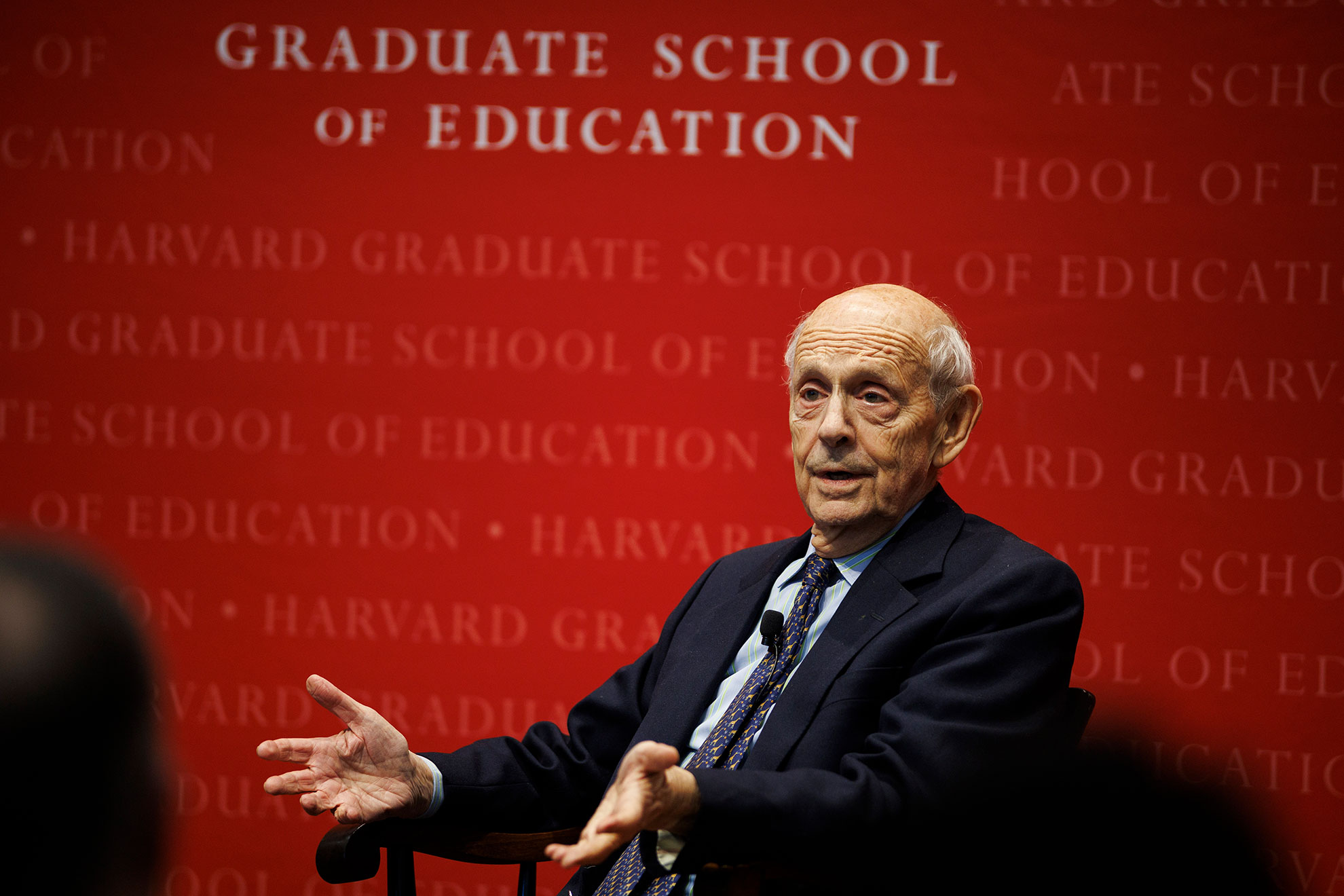
Retired Supreme Court Justice Stephen Breyer emphasized the importance of civic education as a means to reduce polarization and enhance citizenship during a recent forum at the Ed School. Speaking with Martin West, Breyer expressed concern about the current climate of disagreement and suggested that reinstating civics education in 12th grade could be a long-term solution. The conversation took place on April 21.
Reflecting on his own experience in San Francisco public schools, Breyer recounted how civic education fostered his interest in public service and underscored the significance of civic engagement. He recalled activities like visiting the California legislature and participating in ‘Youth in Government Day,’ which instilled a sense of responsibility in students.
Throughout his career, Breyer has championed the role of education in bolstering democracy. His writings, including “Making Our Democracy Work: A Judge’s View,” highlight this belief. In 2021, he authored a decision supporting student free speech off-campus, asserting that public schools are foundational to democracy.
Regarding the Supreme Court’s role in civic education, Breyer advocated for clear judicial writing to help the public grasp the implications of rulings. He shared an anecdote involving the Dalai Lama’s visit to the Supreme Court, where justices discussed dealing with cases that are legally correct but morally questionable.
Breyer cited his tenure as chief counsel of the U.S. Senate Judiciary Committee in the 1970s, where he learned the value of bipartisan dialogue from Sen. Ted Kennedy. Breyer paraphrased Kennedy’s advice: “Listen carefully, and often you will find common ground.”
He acknowledged the efforts of various foundations advancing civic education among younger students and highlighted his involvement with the Annenberg Classroom at the University of Pennsylvania. Breyer remains hopeful about the younger generation’s dedication to civic involvement and public service, noting their enthusiasm and potential to address societal challenges.
Original Source: news.harvard.edu