




Concrete ranks as the most commonly used building material globally but is a major contributor to carbon emissions. A potential method to lessen its environmental impact involves 3D printing concrete, layering it like a massive icing dispenser. This technique avoids the need for labor-intensive molds and applies material solely where required. However, many computer-generated efficient designs can’t be constructed with current printers.
Engineers employ topology optimization to identify the most robust structure using minimal material. Yet, these complex designs are challenging for large-scale concrete printers due to their thick nozzles, limited turning, and the necessity for continuous printing. MIT researchers have developed a framework that integrates these constraints into the design process, allowing machines to create and print designs with minimal manual alterations.
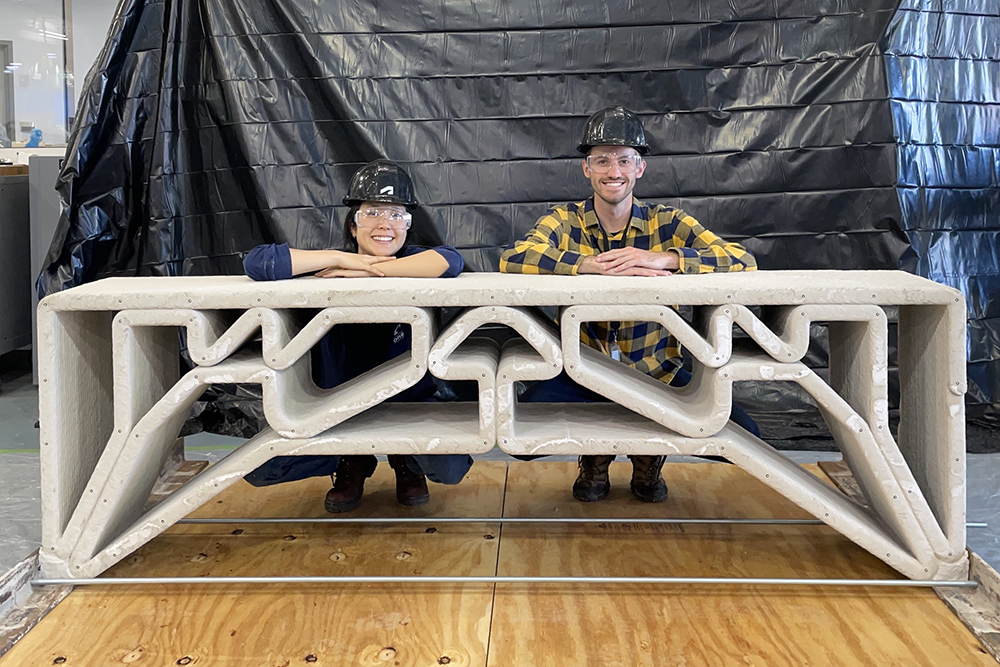
The team showcased this by designing, printing, and testing a 2.3-meter concrete bridge, discovering that current printing technology, not concrete, limits structural lightness. “We were finding a lot of cracks you can fall through when it comes to translating these super-optimal designs into manufacturable designs,” said Hajin Kim-Tackowiak, co-first author and MIT postdoc.
To identify constraints, the team collaborated with Autodesk’s Technology Center in Boston. Engineers highlighted issues with sharp angles, revealing three main limitations: bead thickness, nozzle turning capability, and continuous line printing. These were incorporated into the mathematical framework, allowing rapid design adjustments.
Existing 3D-printed structures often require extensive post-processing, but the new framework generates designs in minutes. Zane Schemmer, co-first author, notes that advancements in mixed-integer optimization have made this approach feasible only recently.
After printing a 2.3-meter concrete bridge, the team found it could support over 2,000 pounds with minimal bending, aligning with their simulations. However, the study revealed that the bridge was over-engineered, as printer limitations dictated design efficiency. “From zero to 200,000 pounds, your design is entirely driven by these ‘can I build it or not’ constraints,” Kim-Tackowiak explained.
The research highlights how machine improvements could enhance efficiency and reduce concrete’s carbon footprint. The width of the printed bead was identified as a major factor. Reducing bead width from 4 cm to 1 cm could cut material use by 76% while maintaining safety margins, according to Josephine Carstensen.
Concrete’s strength in compression was a key factor in the bridge’s design. After testing, lifting one corner to sweep beneath it caused the bridge to break, demonstrating concrete’s weakness under tension. The next phase involves exploring reinforced concrete structures, with Kim-Tackowiak noting challenges in integrating rebar into printed designs.
The project, funded by the National Science Foundation and supported by MIT’s Center for Advanced Production Technologies, included co-authors Pittipat Wongsittikan and Jackson Jewett alongside Kim-Tackowiak, Schemmer, and Carstensen.
Original Source: news.mit.edu