





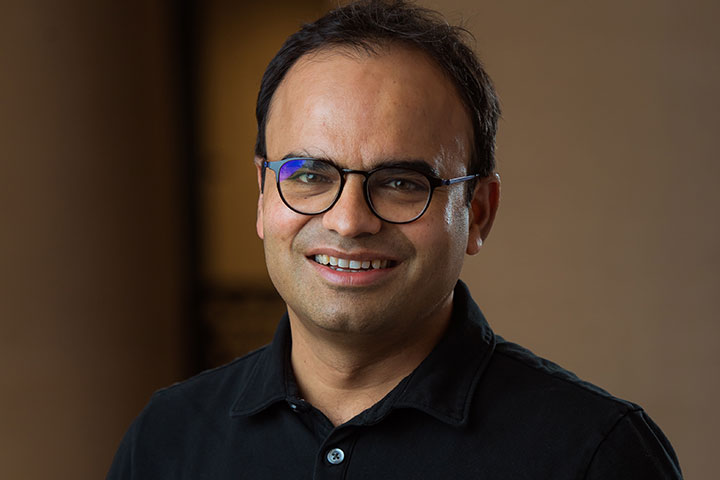
Artificial intelligence systems aimed at improving business forecasting, planning, and decision-making have surged recently. However, these systems often lack detailed organizational information, limiting their effectiveness. Devavrat Shah, a principal investigator at MIT’s Laboratory for Information and Decision Systems, is working on designing methods for second-by-second decision-making with limited computing resources. “In a sense, with a small amount of resource, you have to do a lot of heavy lifting,” Shah states. His research focuses on developing methods to extract information from data effectively.
Shah, a professor at MIT since 2005, co-founded Ikigai Labs in 2019. This spinoff company developed a foundation model for tabular, time series data, stemming from extensive research in Shah’s lab and patented by MIT. The model processes enterprise data from multiple sources, learning continuously by testing predictions against actual outcomes. Shah compares the system to graphical models used by GPS devices and communication systems, which convert limited data into accurate models.
The system differs from most AI models that use text and images by utilizing tabular data, familiar in spreadsheet formats, for real-time and large-scale planning. Ikigai aims to provide forecasting and decision-making technology for major businesses, such as consumer goods and pharmaceutical companies. Shah illustrates its application with a consumer electronics company, which needs to manage supply chains, marketing, and product development. The system helps optimize these interdependent processes by making predictions and adjustments in real-time.
Ikigai was recently acquired by Celonis, where Shah now serves as chief scientist. He envisions his model assisting Celonis in integrating company data to produce practical analyses for forecasts and decisions. Celonis, which has digitized operations for over 1,400 large companies, offers a platform for Ikigai’s software to simulate options, predict strategies, and forecast decision outcomes. “Once the digital layer of these processes exists and this information layer exists,” Shah explains, “we can put the Ikigai stack to enable decision-making at a much larger scale than otherwise.”
Shah emphasizes that while many companies explore AI, his focus is on structured or time-domain data, often overlooked by others. This focus allows for a cost-effective AI version. “A narrower focus comes with sharper technology,” Shah notes, “but it’s broad enough that it’s very valuable.” He adds that the modern AI term “world model” is akin to building an enterprise process world model.
Original Source: news.mit.edu