







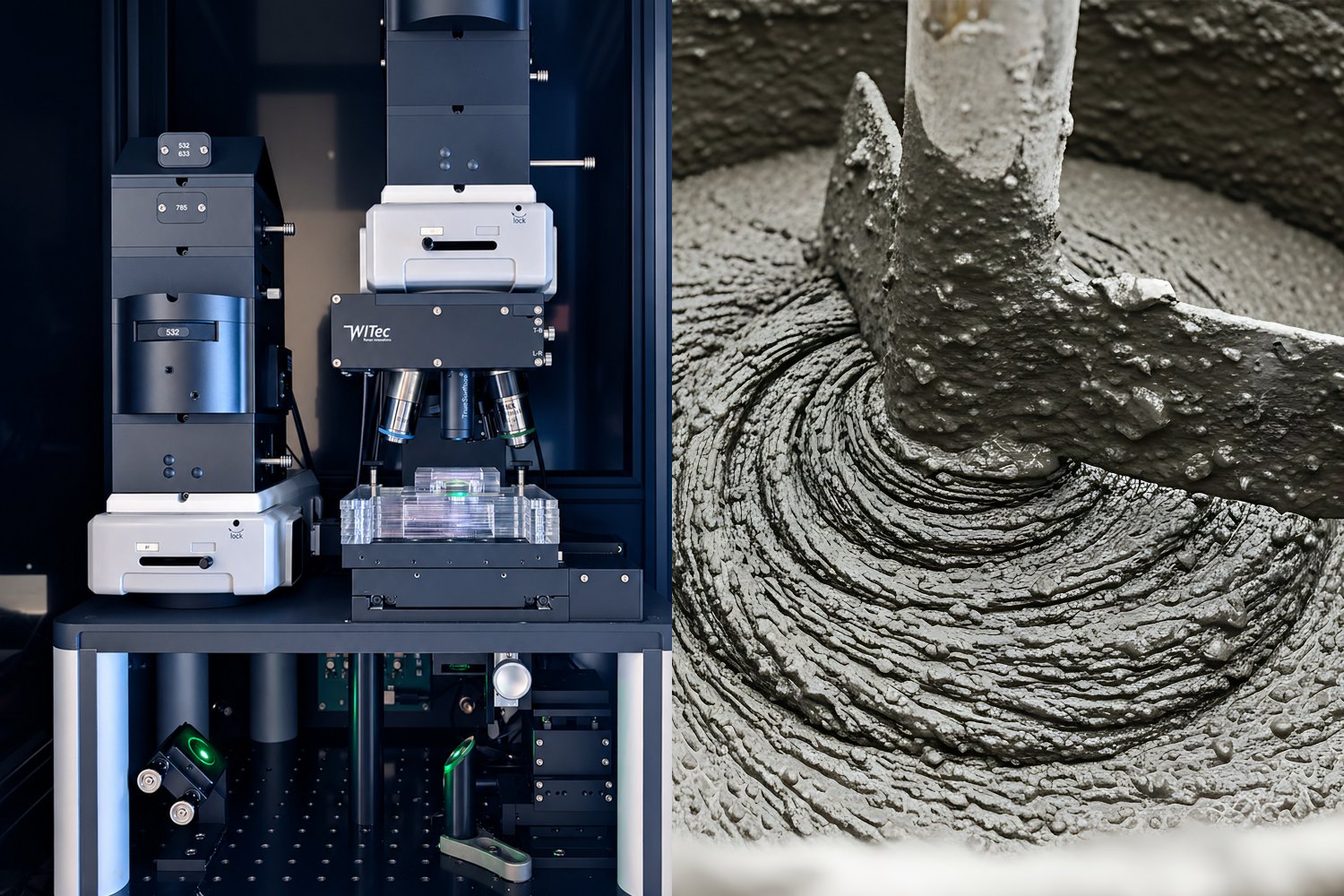
On a day in September, snowflakes began to fall inside MIT’s Pierce Laboratory. Researchers released liquid carbon dioxide from a pressurized tank, causing it to freeze into solid particles. These were mixed into cement paste and formed into small discs, sealed with vegetable oil to preserve moisture and exclude air. Lasers were used to track the chemical reaction, revealing how CO2-injected cement paste gains strength more rapidly.
Injecting carbon dioxide into cement products like concrete offers a method for carbon storage, drawing commercial interest. Several companies now provide CO2-infused concrete mixes, yet the fundamental chemistry had not been directly observed until now. A new study published in the Journal of the American Ceramic Society, led by Associate Professor Admir Masic and graduate student Marcin Hajduczek from MIT, outlines the chemical process that occurs when CO2 meets fresh cement paste. Collaborators include MIT’s Santiago El Awad and Franz-Josef Ulm, with researchers from IIT Jodhpur and CarbonCure Technologies.
Previous research relied on theoretical models and indirect evidence to understand the chemical effects of CO2 injection, as the reactions were too rapid for conventional methods to capture. Raman confocal microscopy, which identifies materials through laser illumination, provided new insights. This technology reveals the unique spectral “fingerprint” of chemical bonds, allowing fleeting phases to be detected. “We’ve used Raman spectroscopy to study significant historical materials,” noted Masic, “and now we can visualize CO2-injected cement paste as it hardens.”
The research documented a three-phase chemical process over 24 hours. Initially, CO2 dissolves in the pore solution of fresh cement paste, reacting with calcium from the dissolving clinker to form calcium carbonate. This slows the normal hydration process, which relies on calcium. Without CO2, calcium aids the formation of binding phases as the cement sets. The absence of calcium causes silicates to form an interconnected silica gel network.
Once the CO2 is mineralized, normal hydration resumes, and calcium hydroxide forms, interacting with the silica gel to produce calcium silicate hydrate (C-S-H), the binding agent in cement. Unlike conventional hydration where C-S-H clusters around clinker particles, in this case, it forms throughout the matrix. As the pH rises, the silica gel reacts with calcium hydroxide, rapidly converting into additional C-S-H within eight hours. Hajduczek remarked on the unexpected disappearance of the silica gel in CO2-injected samples.
With the silica gel utilized, the cement returns to typical hydration, but with a stronger and more uniform microstructure. CO2-injected cement demonstrated a 13 percent increase in compressive strength after 24 hours compared to standard mixtures. Masic stated, “Understanding the mechanism allows us to control and enhance performance. There’s potential for significant improvement.”
The findings challenge prior beliefs that calcium carbonate crystals initiate C-S-H growth, suggesting instead that they are passive elements within the silica gel template. Further research aims to measure the mechanical properties of the new C-S-H distribution. While high CO2 levels can impede gel formation, the study suggests potential carbon emission reductions from cement production. Although practical offsets may be limited, the research has captured the elusive silica gel, making the early chemistry visible.
Original Source: news.mit.edu