

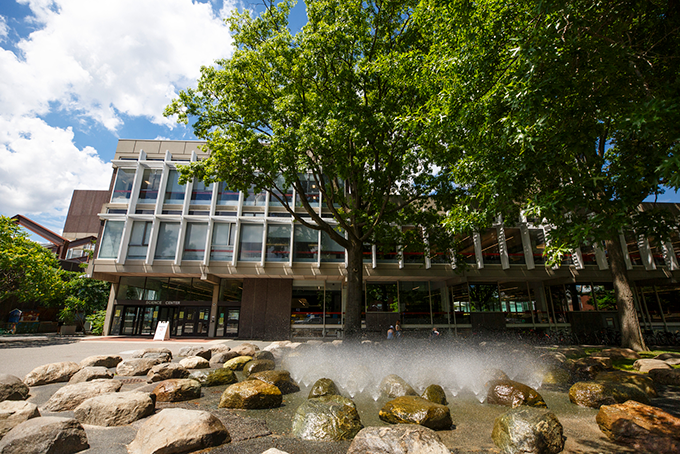
Harvard University revealed on Friday that the Science Center located on Oxford Street will be renamed Zimmer Hall. This change honors a $100 million donation made by the Zimmer Family Foundation in 2018.
Alan Zimmer, father of Stuart Zimmer ’91, was a pioneering American neuroradiologist in the development of CAT and MRI technology in the U.S. Stuart and Jennifer Zimmer have also contributed to enhancing kosher dining for Harvard students.
President Alan Garber expressed deep gratitude to Stuart and Jennifer Zimmer for their exceptional generosity, noting their role in advancing scientific understanding and supporting Harvard’s Jewish community. Their contributions will have a lasting impact on students and scholars working on urgent global issues.
The Zimmer family’s contributions will improve kosher dining options on campus, such as expanding menu variety and providing kosher meals at Eliot House post-renovation. In 2024, Harvard increased kosher dining offerings at Harvard Hillel, the Quad, and Annenberg.
Stuart Zimmer expressed pride in their support, hoping to inspire students to pursue knowledge and ensure Jewish students feel welcomed at Harvard. The Science Center’s renaming aims to foster a sense of tradition and belonging.
The newly named Zimmer Hall, a central hub for undergraduate science and math, has seen significant renovations since 2018, including updated teaching labs and transformed lecture halls and lobby.
Hopi Hoekstra, Edgerley Family Dean of the FAS, emphasized the gift’s impact on the Faculty of Arts and Sciences, enhancing state-of-the-art science and math education and investing in student life and community.
The Science Center, designed by Josep Lluis Sert and built in 1972, houses several departments and facilities, including the Cabot Science Library and Pritzker Commons.
Born in New York City in 1929, Alan Zimmer earned his MD from the University of Geneva in 1956. He completed neuroradiology fellowships at various prestigious institutions and served as associate professor of radiology at the University of Medicine and Dentistry of New Jersey until his passing in 1993. His work in neurovascular imaging earned recognition from several medical organizations.
Original Source: news.harvard.edu