









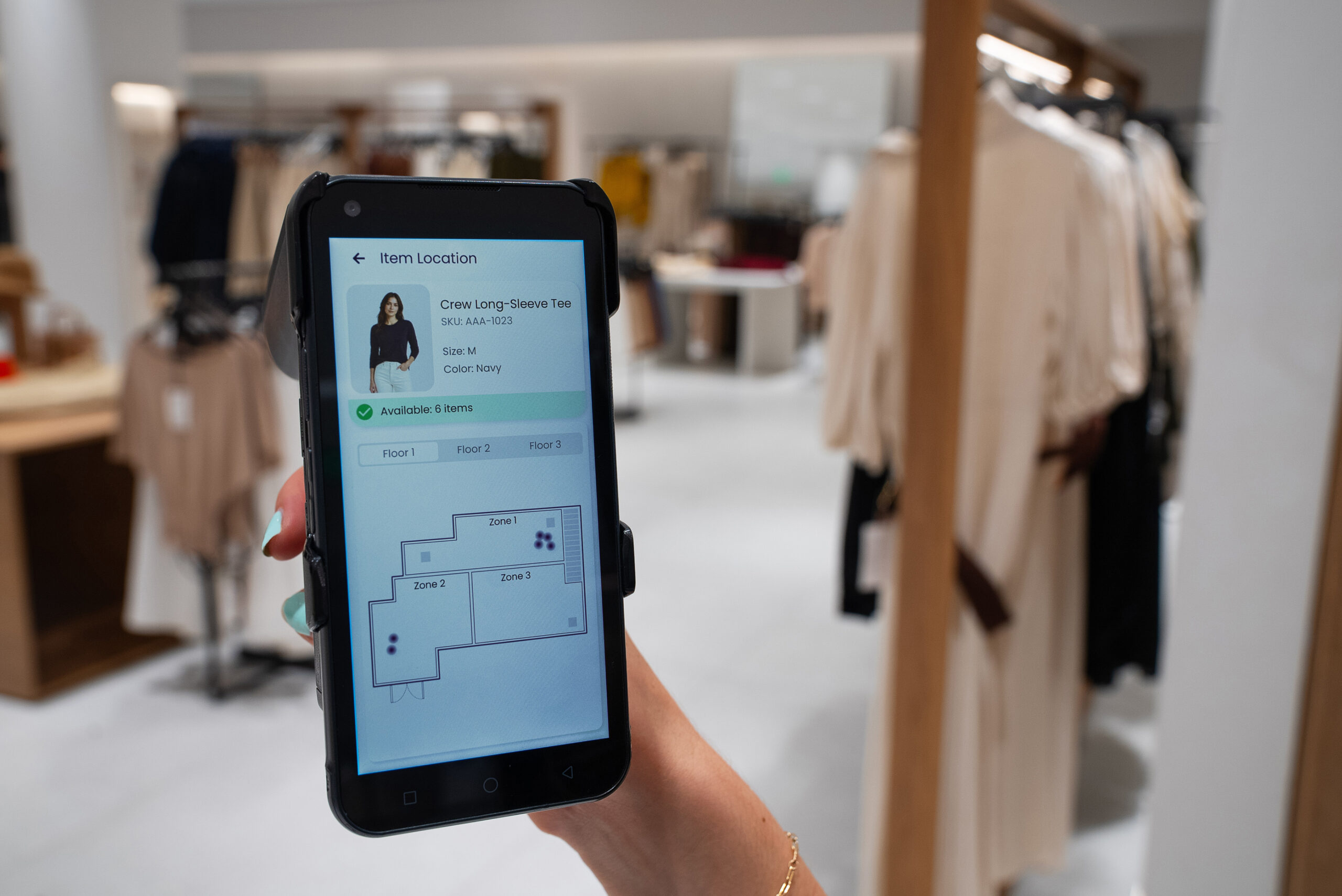
Typically, when envisioning a retail worker, one might think of someone assisting customers or handling transactions. However, a significant portion of their time is spent organizing stockrooms and shop floors, handling online orders, and managing inventory. Determining inventory locations often consumes time as retailers may not know where items are precisely. This is why a store employee might take 20 minutes to confirm the availability of a shirt in your size.
Cartesian is addressing this issue by offering a solution developed at MIT that uses RFID tags to track items’ exact locations in stores, from storage areas to sales floors. A study conducted last year with a retailer demonstrated that Cartesian’s platform could significantly reduce store-level costs by enhancing inventory management, optimizing processes, and improving customer service.
Fadel Adib, co-founder and MIT associate professor, states, “The major challenge we’re tackling is that roughly 50% of retail work hours are devoted to inventory management,” which equates to a $15 billion problem in the U.S. The system uses algorithms to determine item locations indoors via wireless signals, ushering in advanced indoor localization. Cartesian’s technology is already operational in over 700 stores across 15 countries, including collaborations with major fashion groups like Inditex, the company behind brands such as ZARA and Pull&Bear.
Cartesian’s platform is not limited to retail and warehouses; it could also enhance location tracking for manufacturing, logistics, and robotics sectors. “Our broad vision is spatial AI,” Adib explains, highlighting the transition of AI from digital to physical spaces, enabling machines to perceive and interact with their surroundings.
Adib, with a background in wireless signal research at MIT, initially worked on indoor localization using RFID tags. He and Isaac Perper developed algorithms that process RFID data, helping robots locate RFIDs indoors. In 2021, through the NSF’s I-Corps program, Adib recognized the significant inventory management challenges retailers face.
Adib and Perper founded Cartesian in early 2023, following a small business award from the NSF. With support from MIT’s Technology Licensing Office and Venture Mentoring Service, they aimed to make the technology scalable. Perper focused on simplifying and speeding up the product using machine learning advancements.
Retail workers spend considerable time locating items for restocking, fulfilling online orders, or responding to customer inquiries. Inventory systems often become outdated, leading to inefficient item searches, which can frustrate customers and waste employee time, as Adib notes.
Cartesian’s platform integrates with existing RFID readers used by store associates. Stores can install Cartesian’s software into their current inventory systems, facilitating item tracking. “The RFID readers indicate stock levels,” Perper explains, highlighting how their system uses existing scans to create item location maps.
Retailers can leverage Cartesian’s technology to monitor inventory, guide customers to items, and develop additional services. “Our location intelligence platform allows for product development,” Adib states, emphasizing its versatility with any store or RFID type.
Since signing its first major contract in 2025, Cartesian has rapidly expanded to hundreds of stores. Perper notes that integrating the system in a new store takes about a minute, without the need for on-site visits. “It’s as easy as flipping a switch,” he says, underscoring the decision to utilize existing hardware.
Cartesian plans to expand its technology beyond retail to manufacturing, warehouses, and other fields. “Currently, our focus is on retail, but our technology holds potential in other sectors,” Adib mentions. The team aims to deploy in tens of thousands of stores within a year and then explore applications in fields like manufacturing and robotics.
Perper finds excitement in Cartesian’s technological foundation and its potential for diverse applications. “Having established the fundamentals, we can now explore specific applications and address challenges across various sectors,” he concludes.
Original Source: news.mit.edu