




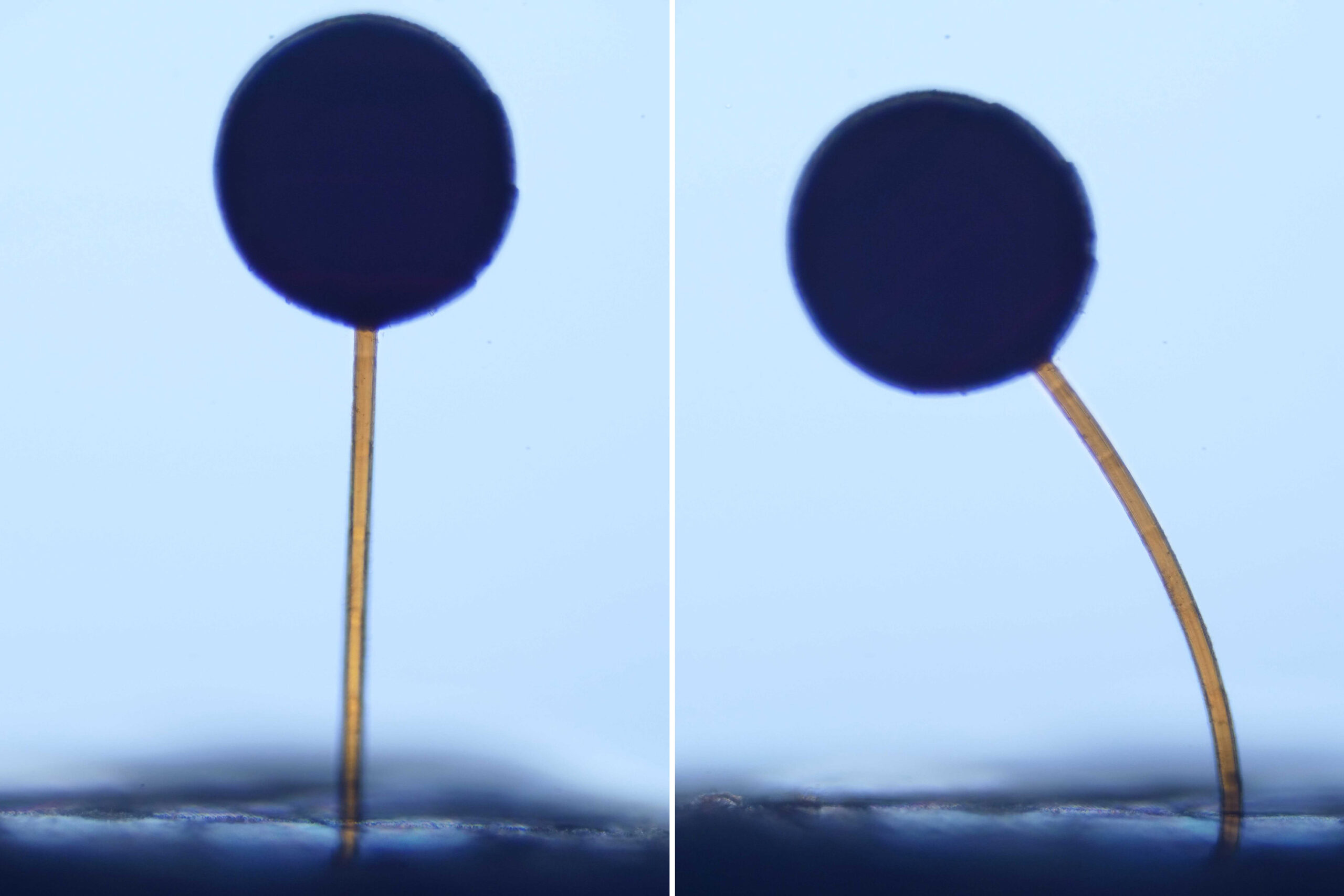
Under a microscope, tiny lollipop-shaped structures, smaller than grains of sand, gently float in a liquid-filled petri dish. Suddenly, these structures snap together like a Venus flytrap when a scientist moves a small magnet above the dish. These previously passive forms have been transformed into an active robotic gripper.
This gripper demonstration showcases a new type of soft magnetic hydrogel developed by MIT engineers in collaboration with researchers from the École Polytechnique Fédérale de Lausanne (EPFL) and the University of Cincinnati. The study, published in the journal Matter, details a novel method for printing and fabricating the gel into complex, magnetically activated 3D structures.
The gel could serve as a foundation for soft, microscopic, magnetically responsive robots and materials. These magno-bots might be used in medical applications, like delivering drugs or collecting biopsies through magnetic direction.
Magnetically moving objects is not new; for example, a magnet can move paper clips. Scientists have designed magnetic “micro-swimmers” that can navigate small spaces. Typically, these designs involve mixing magnetic particles into a resin and using an external magnet to guide them. However, MIT’s new material allows for more complex and deformable structures with micron-scale precision, enabling intricate maneuvers.
“We can now create a soft, intricate 3D architecture with components that can move and deform in complex ways within the same microscopic structure,” said Carlos Portela, an MIT professor and study author. This capability could revolutionize soft microscopic robotics and stimuli-responsive materials.
The MIT co-authors, including graduate students Rachel Sun and Andrew Chen, worked alongside Yiming Ji and Daryl Yee from EPFL and Eric Stewart from the University of Cincinnati.
Portela’s group at MIT develops unique metamaterials with microscopic architectures that result in exceptional properties. Recently, Portela has explored “programmable” materials that change properties in response to stimuli like chemicals, light, and magnetic fields. Magnetic stimuli are noteworthy for their instant, remote control.
Andrew Chen, a co-lead author, stated, “With a magnetically responsive material, we have control at a distance, and the response is instantaneous.” The team aimed to create magnetically responsive metamaterials smaller than a millimeter using two-photon lithography, a high-resolution 3D printing technique.
While resin printing can produce intricate microstructures, printing magnetic structures is challenging. Mixing resin with magnetic nanoparticles can scatter light and weaken structures. The researchers developed a new method combining 3D resin printing with a double-dip process.
Initially, they used standard resin printing to craft a microstructure from a polymer gel without magnetic particles. They then immersed the printed gel in an iron ion solution, allowing absorption. A second dip in hydroxide ions resulted in the formation of inherently magnetic iron-oxide nanoparticles.
This technique allows the team to print structures smaller than a millimeter and add magnetic properties afterward. By adjusting the laser’s power during printing, they control the gel’s “tightness,” affecting magnetic particle formation.
“This provides unprecedented design freedom to print multifunctional structures and materials at the microscale,” said Sun, a co-lead author. The team demonstrated this by fabricating ball-and-stick structures that resemble tiny lollipops, each infused with varying amounts of magnetic particles.
Under a microscope, a regular refrigerator magnet moved the structures to mimic gripping fingers. “You could imagine a magnetic architecture like this could act as a small robot that you could guide through the body with an external magnet, and it could latch onto something, for instance, to take a biopsy,” Portela suggested.
The team also created a magnetically responsive, “bistable” switch by printing a small rectangle of polymer gel with attached magnetic oars. Applying a magnet flipped the oars and shifted the rectangle’s position, acting as a switch. “We think this is a new kind of bistable mechanism,” Portela noted, suggesting potential uses in microfluidic devices as magnetic valves.
This research was partially supported by the National Science Foundation and the MathWorks seed grant program and conducted in the MIT.nano fabrication and characterization facilities.
Original Source: news.mit.edu