








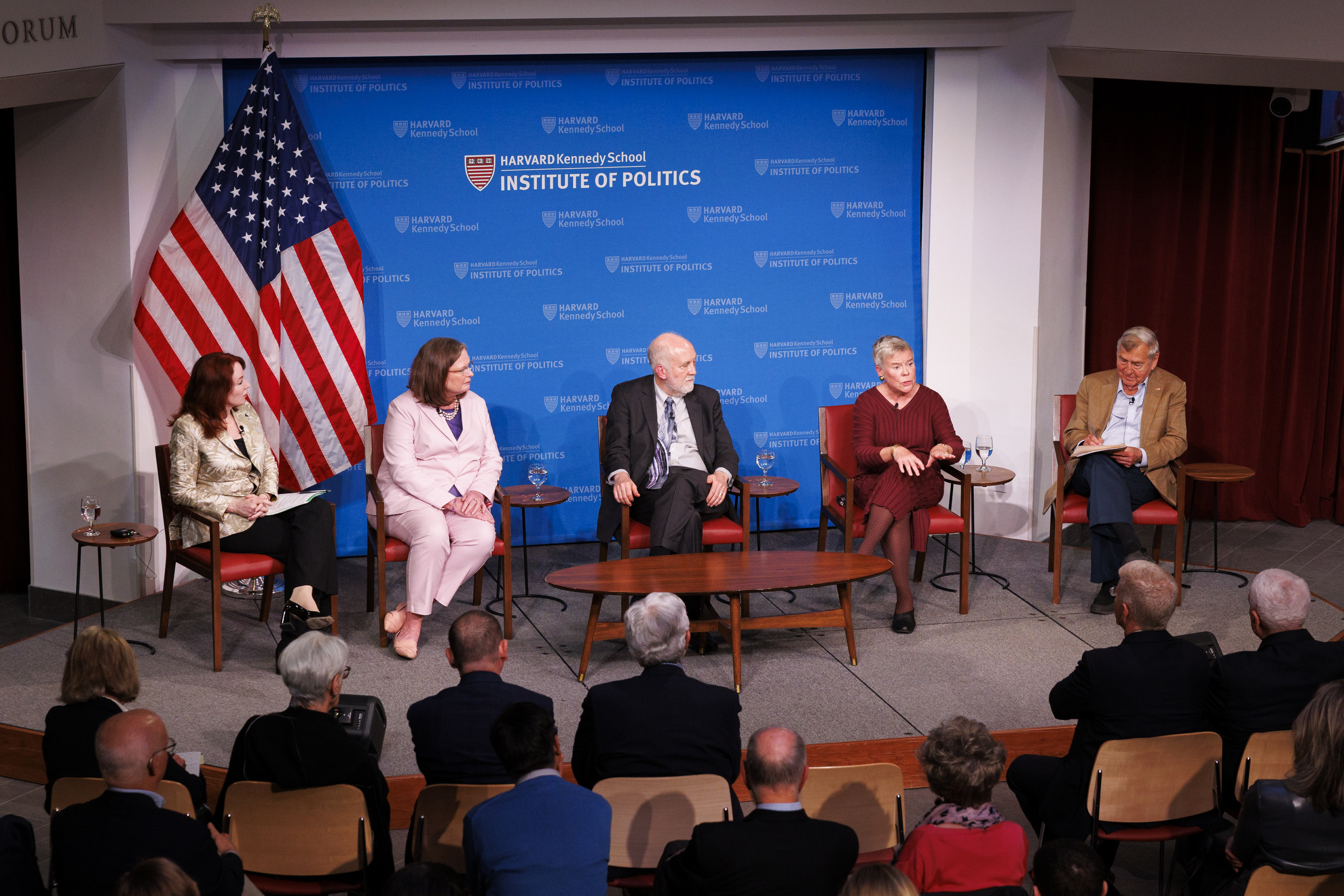
Scholars and practitioners at a recent Harvard Kennedy School event discussed the growing challenges to global nuclear security. Iran’s nuclear ambitions, central to its conflict with the U.S. and Israel, are among several issues threatening decades of nuclear nonproliferation efforts. The event, led by Meghan O’Sullivan, director of the Belfer Center for Science and International Affairs, highlighted the changing dynamics of nuclear nonproliferation and its significance for U.S. national security, especially as China seeks to match the nuclear capabilities of the U.S. and Russia.
Matthew Bunn, a professor at Harvard Kennedy School, warned of a potential new nuclear arms race. This concern arises from the possibility first predicted by President John F. Kennedy in 1963, where multiple countries could possess nuclear weapons. This fear led to the creation of the Treaty on the Non-Proliferation of Nuclear Weapons, signed by 191 states, which remains a key framework for controlling nuclear arms and promoting disarmament.
There is a persistent effort by the U.S. to limit the spread of nuclear weapons to both adversaries and allies. Bunn expressed concerns about the risks of numerous countries having nuclear capabilities, which could increase the likelihood of nuclear conflict and potentially involve the United States. Currently, only nine countries are known to have nuclear weapons, a testament to the success of nonproliferation efforts over the past six decades.
However, the stability of treaties and deterrence strategies post-Cold War is eroding, according to a Belfer Center report. With several nuclear agreements lapsing without renewal, and the U.S. showing openness to “allied proliferation,” the traditional nonproliferation stance is shifting. This change is partly due to declining confidence in the U.S. nuclear protection promise, a sentiment echoed by Rose Gottemoeller, a lecturer at Stanford’s Hoover Institution.
Despite concerns, Gottemoeller noted improvements in NATO’s capabilities and infrastructure in Europe. The U.S. has deployed advanced warheads and upgraded bases in the region, and allies have procured F-35 fighter jets for nuclear missions. To maintain a strong deterrent against adversaries like Russia, Gottemoeller emphasized the importance of allies being prepared to act alongside the U.S.
Laura S.H. Holgate, a senior fellow at the Belfer Center, pointed out that China’s influence on the International Atomic Energy Agency is a cause for concern. To counterbalance this, the U.S. should focus on developing safer nuclear power reactors that are less likely to be used for weapons production. Bunn argued that using force to deter countries like Iran from pursuing nuclear weapons is ineffective and illegal.
The current conflict has increased Iran’s motivation to develop nuclear weapons, Bunn noted, predicting a higher likelihood of Iran acquiring such capabilities within the next decade. The event marked the first of a new series by the Belfer Center, named in honor of Albert Carnesale, a prominent figure in nuclear nonproliferation policy.
Original Source: news.harvard.edu