







Next time you relax to the sound of rain, consider how it might appear to a seed beneath the soil. MIT engineers have discovered that some seeds react energetically to rain sounds. Experiments with rice seeds showed that the noise of droplets landing can awaken seeds from dormancy, prompting them to germinate more quickly than those not exposed to such sound vibrations.
Published in Scientific Reports, the study provides the first direct evidence that seeds and seedlings can detect sounds naturally. The researchers worked with rice seeds in shallow water, noting that rice can germinate in both soil and water. The team suspects similar seeds might also react to rain sounds.
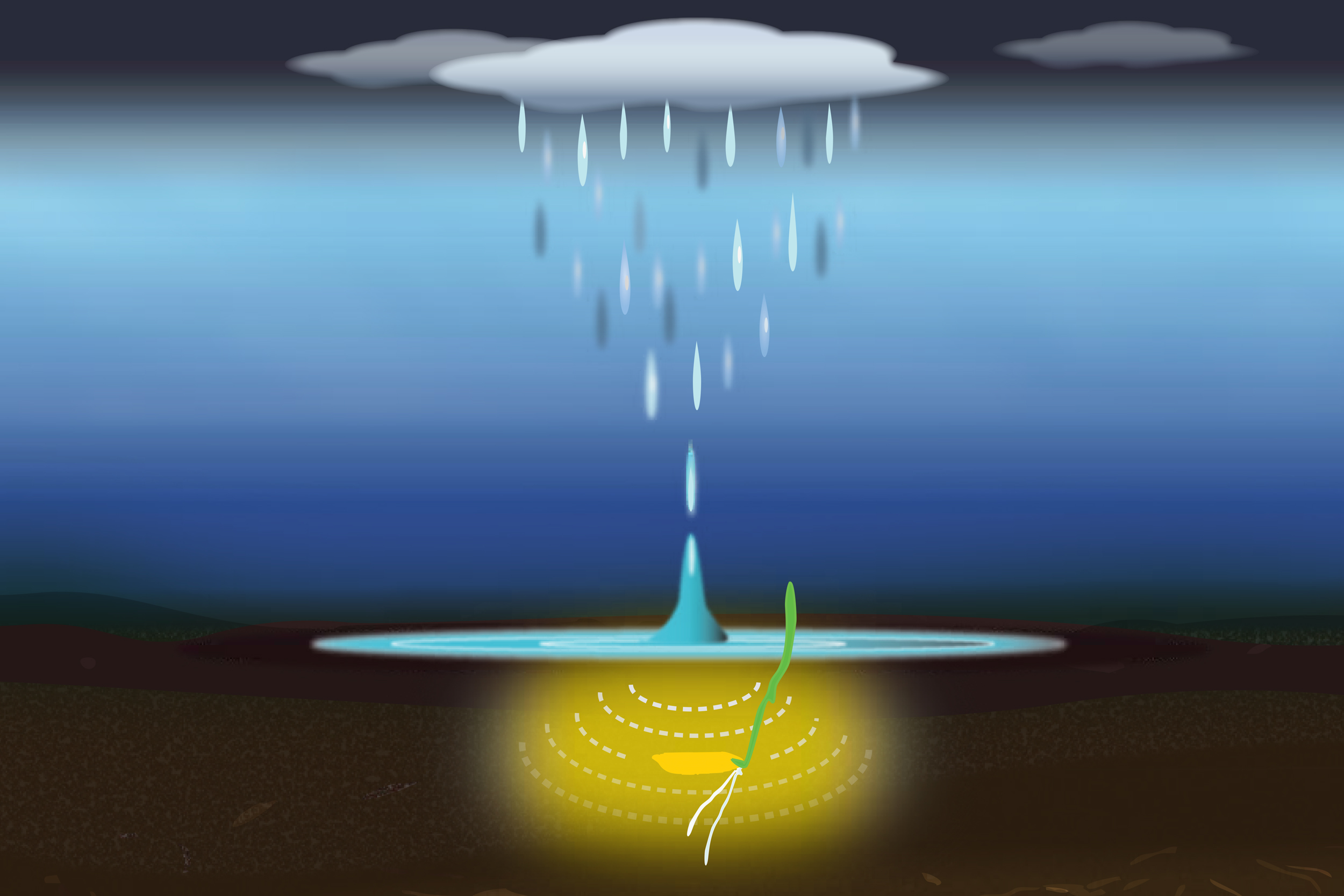
The researchers hypothesized that when raindrops hit the ground or a puddle, the resulting sound waves can vibrate nearby seeds. These vibrations may dislodge “statoliths,” small organelles that sense gravity in seed cells. Their movement signals seeds to sprout and grow. “Seeds can sense sound to aid survival,” says MIT’s Nicholas Makris. The rain’s energy can accelerate seed growth.
Makris and co-author Cadine Navarro, formerly of MIT, believe rain sounds resemble vibrations from other natural events like wind. They plan to explore further how plants perceive sound and vibrations in nature.
Plants are highly perceptive, responding to environmental stimuli. Some react to touch, others to toxic odors, and most grow towards light. Plants also sense gravity, with roots growing downwards and shoots upwards. Statoliths, denser than cytoplasm, settle in cells to guide growth direction. Dislodged statoliths can also trigger seed growth.
Curiosity about seeds and sound led Makris and Navarro to question whether sound could move statoliths and influence growth. They referenced past research on underwater rain sounds, noting that water’s density amplifies sound waves. A seed near a raindrop impact experiences sound pressures comparable to a jet engine in air.
To investigate, they conducted experiments with rice seeds in shallow water, subjecting them to dripping water sounds. The seeds were far enough from droplets that only sound waves affected them. Droplet size and height varied to simulate different rain intensities.
The team measured underwater acoustic vibrations using a hydrophone. Comparisons with natural recordings confirmed their lab droplets created similar acoustic effects. Observations showed seeds exposed to rain sounds germinated 30-40% faster than those that weren’t, especially those closer to the surface.
This suggests a biological advantage for seeds sensing rain. If close enough to respond, they might be optimally positioned to absorb moisture and grow. Calculations showed that rain vibrations could dislodge statoliths, explaining how sound stimulates growth.
Makris and Navarro’s findings align with their calculations: rain sounds can indeed move statoliths, helping plants “sense” rain and grow. “Brilliant research worldwide has explored plant gravity sensing,” Makris says. Their study indicates similar mechanisms help seeds gauge beneficial submergence depths by sensing rain. This connects to the Japanese microseason “Falling rain awakens the soil.” The MIT Bose Fellowship and MIT Koch Chair supported this work.
Original Source: news.mit.edu