



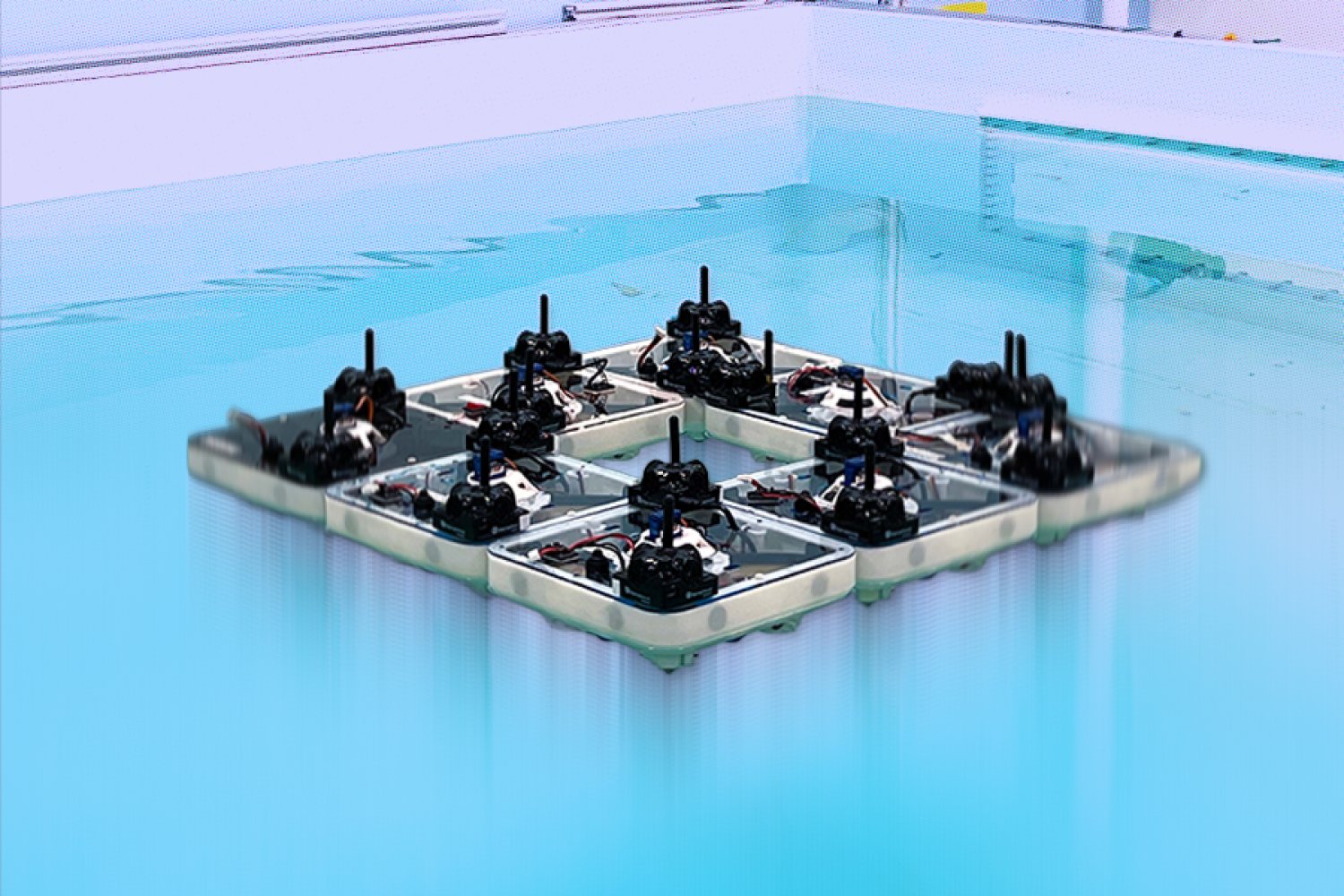
Many view the waterfront as a city boundary, but MIT researchers envision it as a site for dynamic construction. Their “FloatForm” system consists of small, square robotic boats that autonomously assemble into larger structures on water, disassemble, and reconfigure with minimal human input. Each robot, measuring 21 centimeters square, operates independently with thrusters, sensors, and magnetic latches.
Daniela Rus, MIT professor and director of the Computer Science and Artificial Intelligence Laboratory, describes FloatForm as a method to transform waterfronts into programmable city extensions. These autonomous boats could form bridges, platforms, and other structures as needed, enhancing mobility, emergency response, and public space on water.
Wei Wang, lead author of a paper on FloatForm, imagines urban environments where public space can autonomously change. Alejandro Gonzalez-Garcia, a former MIT researcher, sees the system forming water-based infrastructure, like bridges for traffic relief or floating markets and stages.
The open-access study, published in Nature Communications, is a collaboration between MIT labs and grows from Roboat, a project with Amsterdam’s Institute for Advanced Metropolitan Solutions. This initiative tested autonomous vessels on Amsterdam’s canals, exploring their use for waste collection and transport to relieve road stress.
Researcher Niklas Hagemann notes that as urban areas become denser, expanding public space onto underutilized water could be beneficial. FloatForm miniaturizes this concept to find ways to coordinate many floating robots.
The team drew inspiration from fire ants, which survive floods by forming rafts. Each robot is designed to operate independently, similar to ants, to create resilient structures without a central computer dictating every move.
FloatForm utilizes a lightly involved central planner for final positioning, with robots handling navigation, collision avoidance, and adaptation autonomously. This approach ensures scalability, allowing swarms to coordinate efficiently regardless of their size.
Experiments at MIT showed a fleet of eight robots successfully assembling into target shapes, disassembling, and reconfiguring, all within minutes. The decentralized method allows the system to scale smoothly, maintaining efficiency as the swarm size increases.
The robots connect using an origami-inspired mechanism that requires minimal power. This design allows them to conserve energy for movement and computation, crucial given their small size.
Engineering challenges included stabilizing motion and managing strong magnetic latches. Despite these hurdles, the system achieved a high success rate in trials, with the architecture allowing for recovery from errors without disrupting the entire swarm.
Looking ahead, the team aims to transition from controlled tank environments to real-world canals, further testing the system’s capabilities in more complex conditions.
Original Source: news.mit.edu