
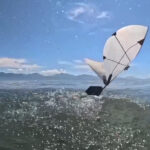
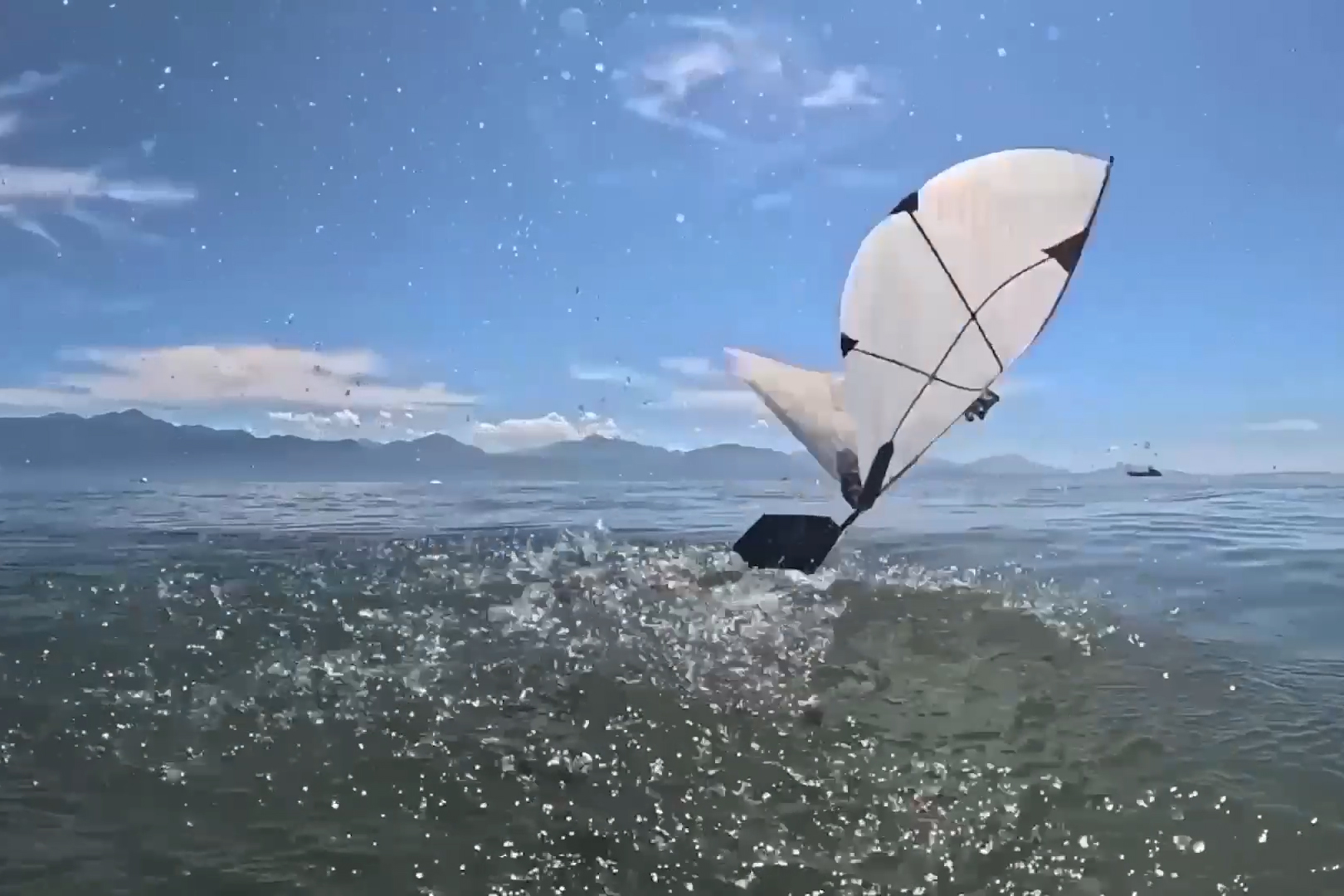
Birds such as loons, gulls, puffins, and petrels are among 100 species capable of both flying and swimming. These diving birds can submerge to chase prey and then take off into the air. Inspired by these creatures, engineers from MIT and EPFL in Lausanne, Switzerland, have developed a robot that can mimic this behavior, moving from underwater swimming to aerial flight. Known as the “flapping-wing aerial-aquatic vehicle” (FAAV), the robot weighs under 300 grams and is designed to help researchers study how diving birds manage to navigate both air and water.
The robot features a central body with two flexible wings and a steerable tail, all of which can be swapped for different sizes. Tests in a water tank and a local lake helped identify the right combinations of wing size, flapping frequency, and tail angle, allowing the robot to transition smoothly from swimming to flying. Published in the journal Science, the findings could aid in understanding the flight mechanics of diving birds and potentially lead to new types of aerial-aquatic drones.
The researchers envision these robots being used in oceanography to access and sample regions that are too hazardous for traditional vessels. Raphael Zufferey, an assistant professor at MIT, explained that the robot could be launched from a boat or shore, fly to areas of interest, dive for samples, and return with data, offering a cost-effective alternative to current methods.
Zufferey leads the AURA Lab at MIT, where his team creates vehicles inspired by natural biomechanics to explore and monitor aquatic environments. The team aimed to design a vehicle capable of adapting between air and water, each of which requires different movement mechanics due to water being 1,000 times denser than air. They found inspiration in birds like puffins that can fly and swim efficiently, using data on their wing flapping frequencies as a reference.
The robot resembles a bird with a body, wings, and tail. Its battery and waterproof motor drive a crankshaft that moves the wings, which are coated with nanoparticles to repel water. The tail’s motor allows for angle adjustments, aiding in the robot’s diving and flying capabilities. Wings were tested in small, medium, and large sizes in both a water tank and Lake Geneva.
During experiments, the robot was placed underwater and programmed to flap its wings and adjust its tail at specific frequencies and angles. It successfully transitioned from swimming to flying with medium-sized wings. The wings’ flexibility proved crucial, as they had to minimize flapping in water while maintaining lift in the air.
The robot swam at speeds of nearly 1 meter per second with a flapping frequency of around 5 hertz and could fly at about 6 meters per second, similar to real diving birds. The optimal pitch for transitioning from water to air was 70 degrees, preventing the wingtips from touching the water’s surface. Unlike many diving birds, the robot does not require feet to take off from the water.
Zufferey noted that while birds often paddle to take off from water, the robot does not need this maneuver. The team plans to enhance the wings to allow turning and test the robot in turbulent conditions. They hope to use it to gather extensive data for ocean science, as Zufferey emphasized the importance of frequent and widespread data collection, which the robot could achieve in the future.
Original Source: news.mit.edu