




In 2022, the construction industry was responsible for over 7% of global carbon emissions due to material production. However, it’s unclear how much of these materials were essential for constructing infrastructure like buildings and bridges. Topology optimization, a technique that can cut material use by up to 90%, could significantly reduce emissions. Despite this, it’s primarily used in research fields such as 3D printing rather than in large-scale construction projects.
The challenge with topology optimization is its tendency to produce complex designs that are difficult to construct within typical time and budget constraints. MIT researchers, however, have developed a method to make these designs more feasible. Their new framework, published in Automation in Construction, allows for the application of constraints on algorithmically generated structures to simplify their complexity. This includes limiting the number of components meeting at any point and specifying the smallest part sizes, while also considering multiple materials and their properties in the design.
Josephine Carstensen, an MIT civil engineering professor, emphasizes the need to balance materials, design feasibility, and structural optimization. The researchers applied their framework to design truss structures using materials like steel and wood, revealing how constraints significantly affect carbon emissions. They aim to bring topology optimization closer to practical use in construction.
Carstensen notes the gap between theoretical carbon savings and real-world application, mainly due to the impracticality of designs generated by topology optimization. By adding constructability constraints, their approach ensures the designs are feasible to build. The paper’s first author, PhD student Zane Schemmer, explored the obstacles preventing industrial adoption of more efficient design methods, aiming to bridge research and practical application.
Recent advancements have made topology optimization more accessible, and Schemmer and Carstensen incorporated these into their study, adding new capabilities like multi-material usage. Sustainability involves not just reducing material use but also utilizing materials efficiently, considering availability and carbon costs.
Their system relies on mixed integer algorithms to make decisions about material use and connections. It considers material properties, like steel’s ability to support compressive loads, to ensure connections meet strength standards. Unlike 3D printing, construction requires different rule sets for materials like timber and steel.
Users can adjust design complexity by setting limits on joint connections and part sizes, enhancing constructability. Schemmer highlights the challenge of providing intricate designs to contractors, as they may be deemed too difficult to construct.
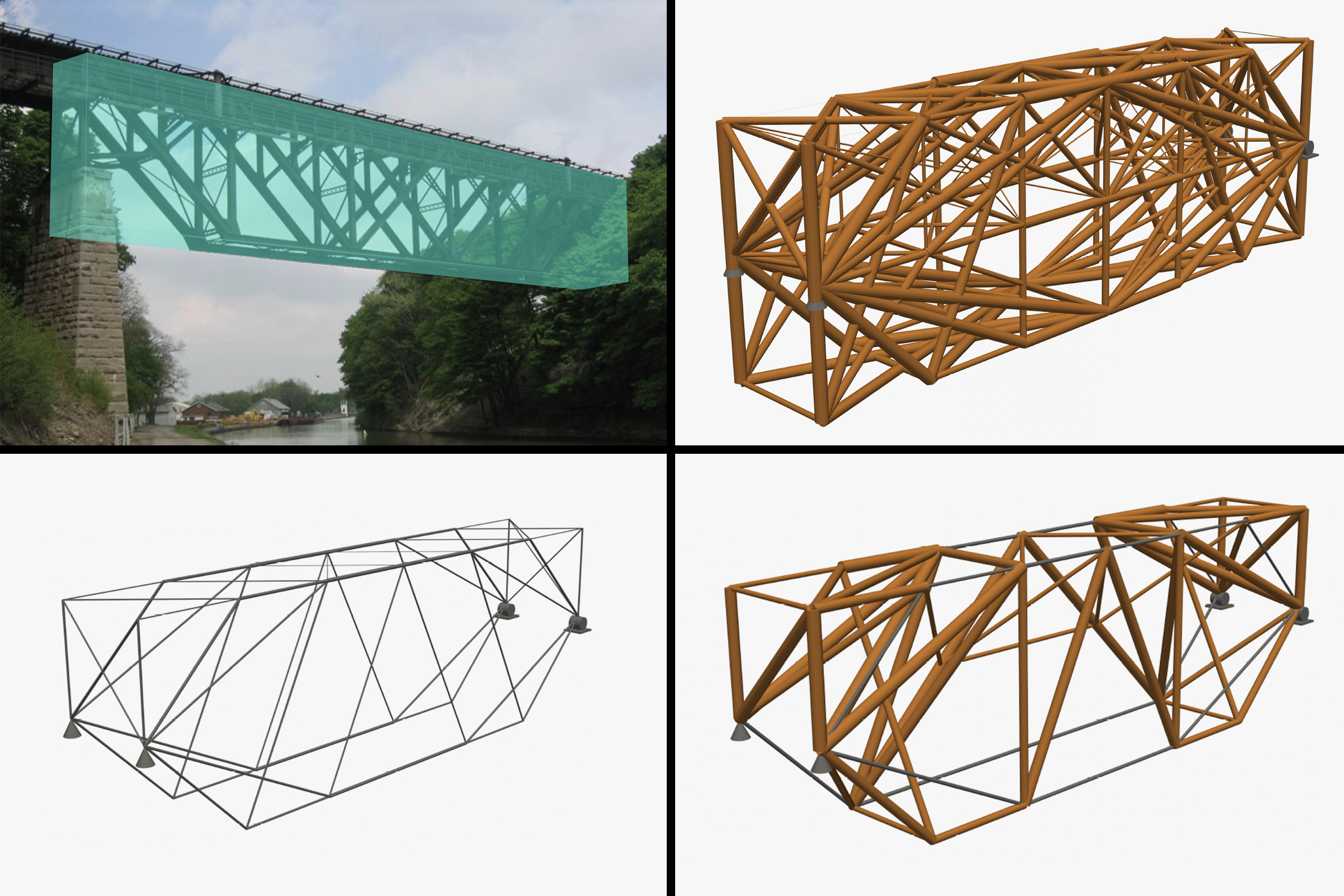
The researchers compared their designs against traditional topology optimization, showing substantial differences in constructability. Using the Lockport “Upside-Down Bridge” as a case study, they applied constraints to understand their impact. Designs using only wood, only steel, or a combination illustrated trade-offs between environmental impact and strength.
Schemmer explains that while a pure steel bridge might not be ideal for carbon reduction, and a pure timber bridge might lack strength, combining materials can yield balanced designs.
Their method is more computationally demanding but feasible with tools like a MacBook Pro. They believe it’s practical for civil engineering firms to adopt. With more resources, their approach could scale to larger projects. The team plans to construct smaller models based on their designs to validate predictions and add further constraints for ease of use in civil engineering.
Schemmer sees addressing the built environment as crucial in combating climate change, emphasizing the importance of considering low-carbon designs during the construction phase.
Original Source: news.mit.edu