

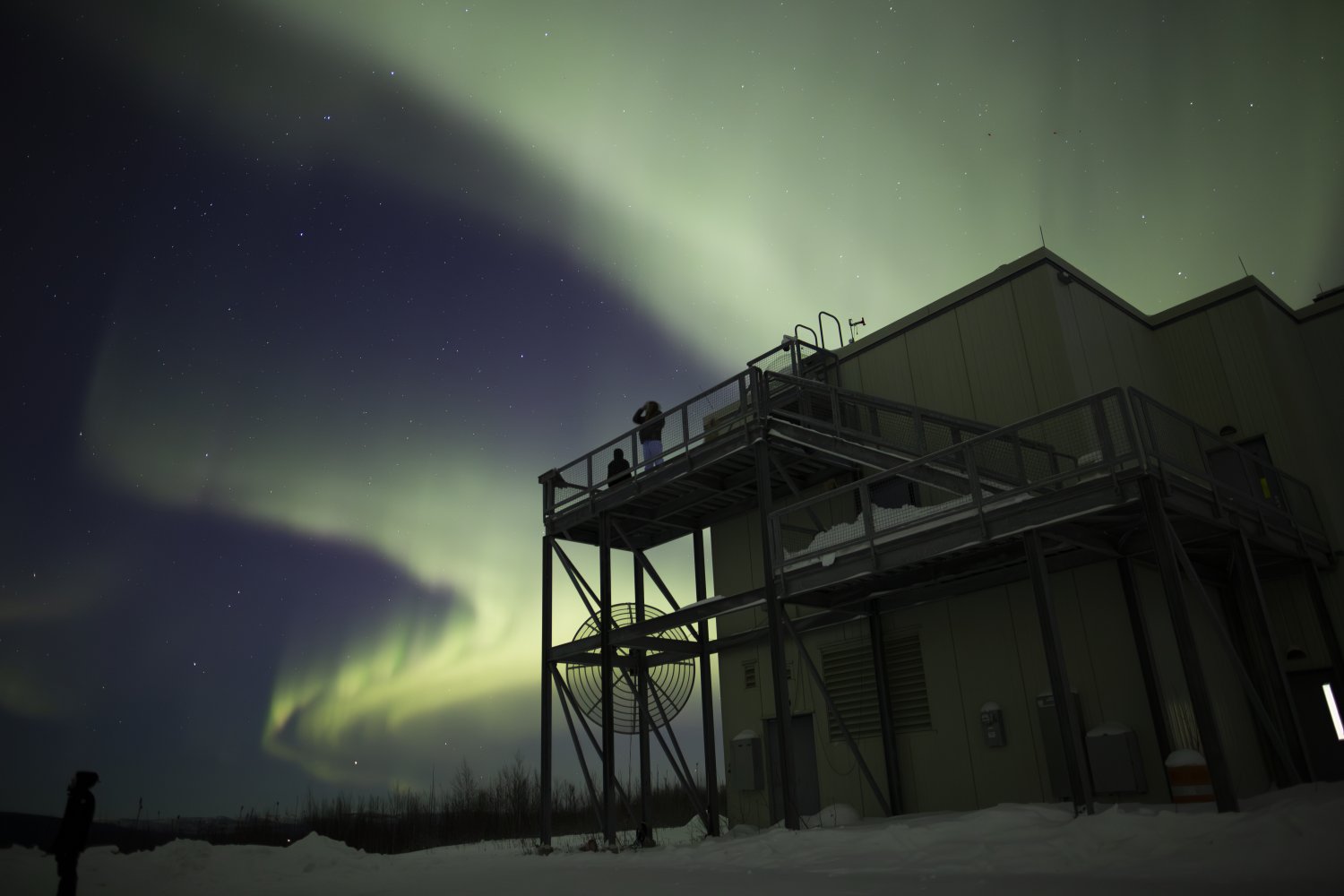
While many graduate students equate a 4 a.m. bedtime with a night well spent, for a group of MIT students, it marked the beginning of their workday. Their schedule was aligned not with the sun, but with the aurora borealis, as they aimed to study plasma phenomena using this natural light display as their laboratory.
These students conducted their research in near-constant darkness in Fairbanks, Alaska, where temperatures plummeted to -25 degrees Fahrenheit. Equipped with red headlamps for visibility, they worked in conditions where the sun set before 3 p.m. and daytime temperatures barely reached 20 F. The aurora provides a unique chance to view plasma behavior, as charged particles interacting with Earth’s magnetic field create visible structures in the sky. Fairbanks, known for frequent auroral activity, is an ideal location for such observations, but the harsh conditions posed challenges.
Extreme cold affected their equipment, as noted by Leonardo Corsaro, a PhD student at MIT’s Plasma Science and Fusion Center (PSFC). “Our laptops went from full battery to nearly empty in 10 minutes because of the cold,” he said, describing the urgency to transfer data quickly. Leon Nichols, another PhD student at PSFC, highlighted the difficulty of moving through thick snow, which can burn 900 calories an hour. The team used cross-country skis to reach remote areas more efficiently.
Their efforts were rewarded when they witnessed the most intense solar storm in two decades, which illuminated the aurora in spectacular ways. “It felt like we were the only ones there,” said Sydney Menne, a PhD student in nuclear science and engineering, describing the immersive experience. The team was granted access to the Poker Flat Research Range through the University of Alaska Fairbanks Geophysical Institute, deploying all-sky cameras and magnetometers over distances of up to 100 miles.
By combining these tools, the team aimed to capture changes in auroral structures across space, hoping to support future three-dimensional reconstructions. This year’s campaign expanded to include muon detectors, exploring potential links between visual auroral activity, magnetic field changes, and particle detections. Despite decades of study, many aspects of the aurora remain enigmatic, offering opportunities to deepen our understanding of plasma behavior in near-Earth space.
The experience reshaped participants’ perspectives on plasma physics. Corsaro remarked that seeing the auroral structures brought a tangible sense of reality to the theoretical concepts of plasma physics. This expedition was part of the Geophysical Plasma Observation Expedition (GPOE), now in its third iteration, involving MIT students from PSFC and other departments. The student-driven project is organized and led entirely by students, covering all aspects of the research process from data collection to analysis.
This year’s team included graduate students Corsaro, Nichols, Menne, Noah Wolfe, and Oleksandra “Sasha” Lukina, accompanied by Professor Matthew Evans. John Ball, a PhD student in nuclear science and engineering, noted the rare opportunity for a compressed scientific cycle, from concept to data analysis, within months. The GPOE began in 2023 when Shon Mackie proposed the idea, and the program has grown from a single-camera effort to a multi-instrument campaign.
The program expanded in 2024 to include outreach with high school students through collaborations with the MIT Museum and MIT Nord Anglia Collaboration. Around 65 students from 20 schools helped design and build components for the all-sky cameras used in Alaska. The team’s low-cost camera and magnetometer designs have gained wider adoption, impacting research beyond MIT.
Original Source: news.mit.edu