

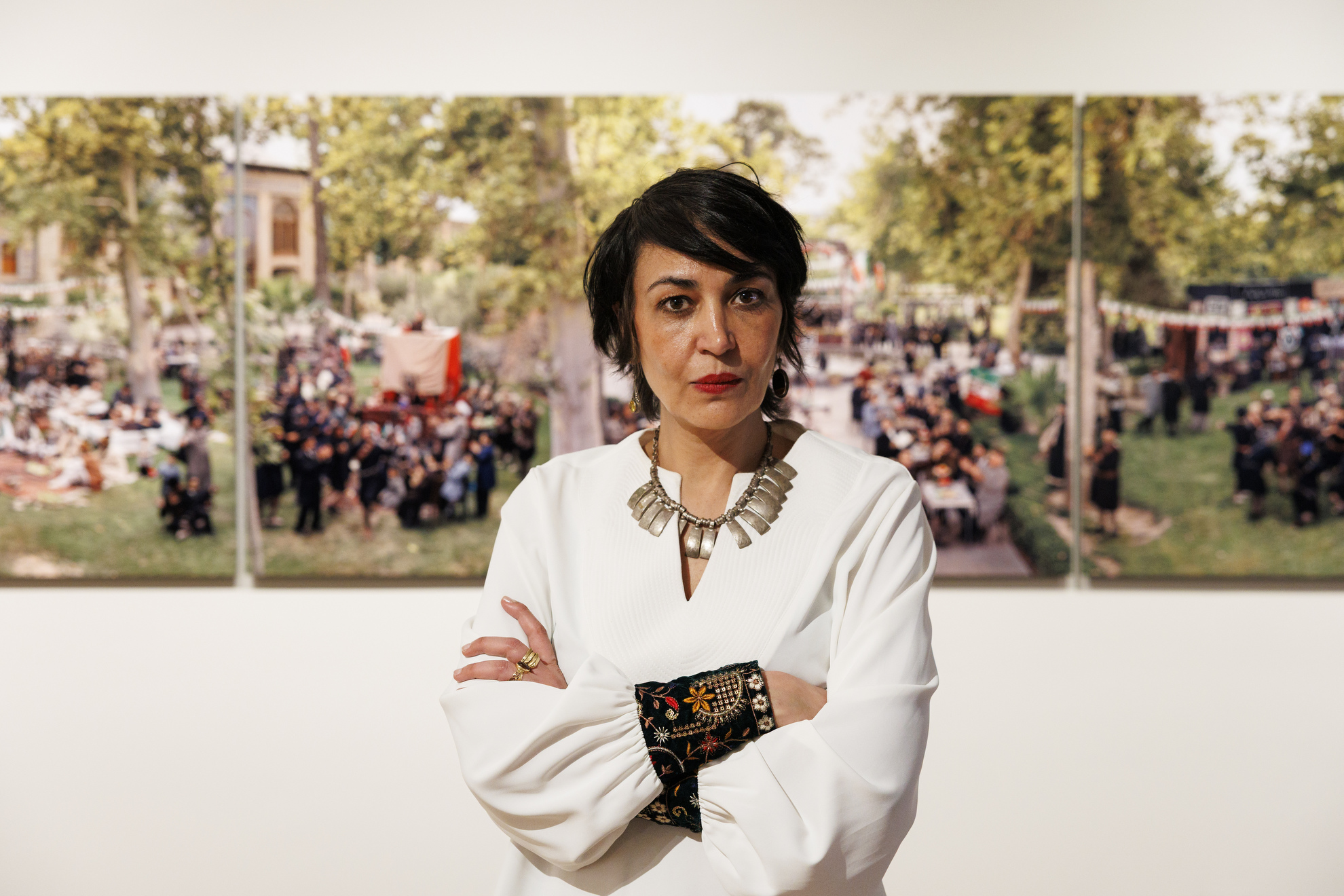
Visual artist Azadeh Akhlaghi has brought pivotal moments from Iran’s 20th century to life through staged photography in an exhibit at the Peabody Museum of Archaeology & Ethnology. Her collection, titled “From Iran: A Visual Testimony,” opened this month and will be on display until March 21. The series covers events from the 1908 Russian-led Cossack Brigade’s attack on Iran’s parliament to the 1979 Islamic Revolution.
Akhlaghi, who was awarded the 2019 Robert Gardner Fellowship in Photography, recreated 11 significant events using archival research and cinema techniques. Her largest piece measures 3 feet by 15 feet. One notable image, “The Mother of Tabriz,” depicts the Russian occupation of Tabriz between 1911 and 1917. Trained in computer science in Australia, Akhlaghi returned to Iran to work in film before shifting to staged photography.
Her previous project, “By an Eyewitness,” began in 2009 following protests in Tehran, where she reconstructed the deaths of Iranian figures who died under suspicious circumstances. This inspired her current work, which showcases themes of military coups and national resistance from 1906 to 1979. “I wanted them to feel like the huge history paintings like you might see in the Louvre,” Akhlaghi said about the photographs.
One image, “The First Iranian Women’s Movement,” was inspired by a brief account in W. Morgan Shuster’s book “The Strangling of Persia.” It depicts women protesters in 1911 preparing to march on Iran’s Parliament. Akhlaghi uncovered that these women organized through secret societies and published a newspaper called Danesh, led by Iran’s first female ophthalmologist.
Akhlaghi acknowledges the challenges of portraying truth through her staged images, as historical records contain contradictions and censored narratives. To highlight her personal interpretation, she includes herself in each image wearing a red scarf. “These are not photojournalistic images: They’re not real. They’re art,” she explained.
While creating this work in Iran posed risks, Akhlaghi set her images between 1908 and 1979 to avoid direct government scrutiny. Some images subtly reference events after 1979, like a hunger strike in 1941 that also alludes to one in 1995. Despite launching the exhibit during a tense political climate, Akhlaghi expressed regret that her first show couldn’t be in Tehran. She hopes the exhibit highlights the recurring cycles in Iranian history and resonates universally.
Original Source: news.harvard.edu