



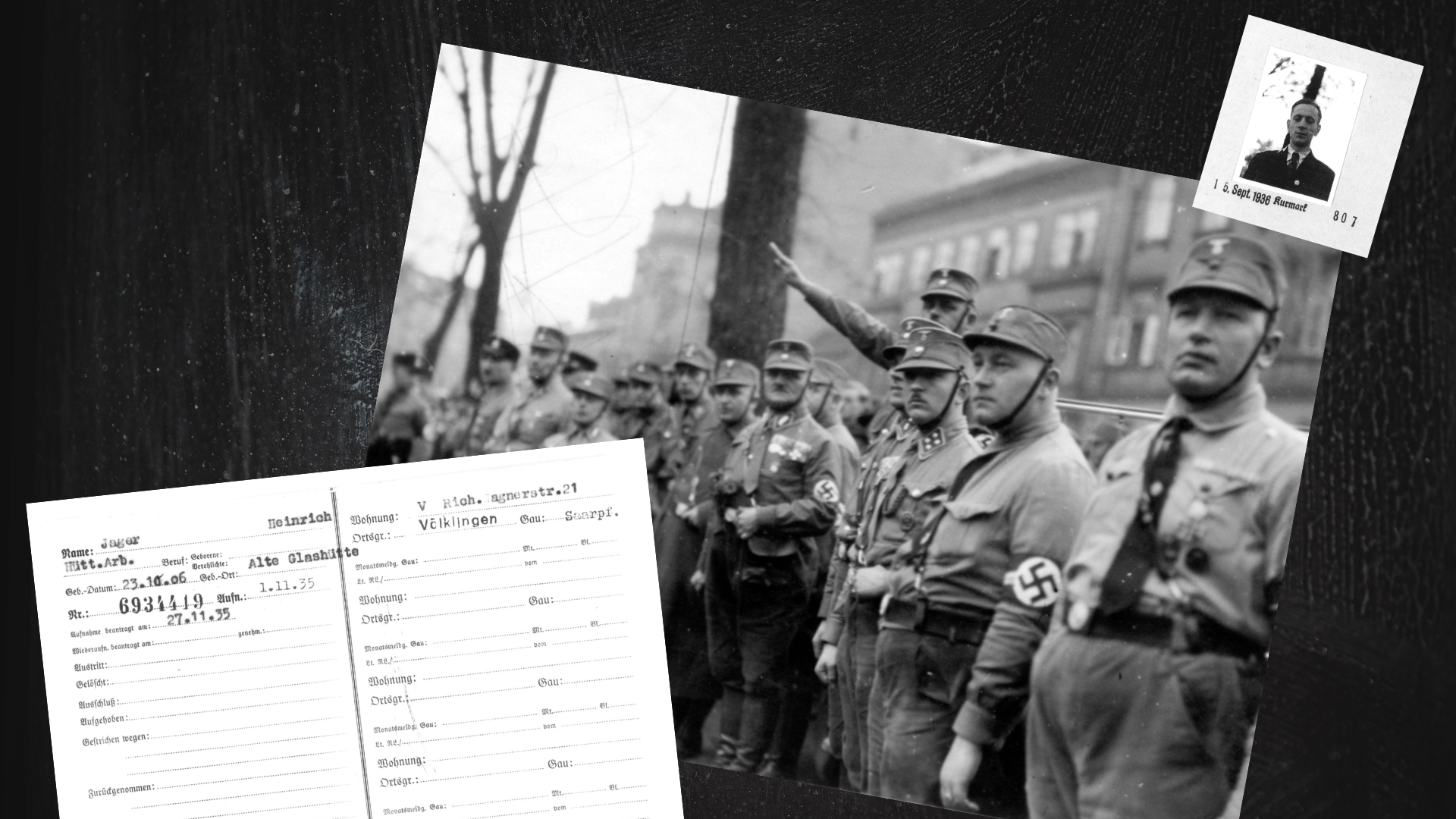
A recent study by Harvard researchers reveals that while early members of the Nazi Party were likely ideological zealots, subsequent joiners were mostly “ordinary men” influenced by propaganda and societal pressures. This research, involving the Economics Department and the Weatherhead Center for International Affairs, utilized vision-language AI to digitize over 10 million membership cards of the National Socialist German Workers’ Party, expanding on a previous database of 55,000. The findings were published by the National Bureau of Economic Research.
According to Luis Bosshart, a co-author of the study, the new data allows for detailed temporal and geographical analysis, showing that mass party enrollment occurred in waves and became more representative over time. By the end of the Nazi regime, members resembled the general population. Under Adolf Hitler, the Nazi Party established a dictatorship in Germany, leading to World War II and the Holocaust. At its peak, one in six Germans were party members. The U.S. National Archives holds microfilm images of these membership cards, which have been challenging to transcribe manually.
Co-author Matthias Weigand noted that the handwritten cards often included edits and crossed-out addresses, complicating manual transcription efforts. Researchers previously relied on random samples, but the new AI model, developed with Google Gemini and the German Federal Archives, provides comprehensive data, including membership photos. Manual verification ensured the model’s accuracy. The study identified significant waves of membership in 1933 and 1937, with early joiners mainly middle-class males from non-agricultural sectors. Differences in membership characteristics decreased over time, aligning with county demographics by 1945.
The research shows that 95% of membership variation existed within counties rather than between them. Municipalities varied significantly in party membership, independent of population density, demographics, or industry. Early Nazi strongholds remained consistent, while areas without initial membership rarely developed it later, with 40% of municipalities having no members. Those joining before 1933 were likely ideologically driven, while later joiners responded to social and political factors.
Weigand highlighted parallels with sociological riot models, where radicals initiate actions, but later participants may not share the same motivations. The study does not delve into members’ beliefs but sets the stage for future research. Bosshart emphasized that explanations must account for differences between neighboring municipalities and the nonlinear dynamics of mass entry. Analysis of first-person accounts from 1934 indicated “national renewal/order” and “social belonging” as primary reasons for joining, over anti-communism or economic concerns.
Bosshart pointed to coordination as a key factor in political change, noting that regime transitions involve uncertainty, and perceptions of new political equilibriums are crucial. He observed similar dynamics after 1945, as former Nazis adapted to democracy. These patterns align with Hannah Arendt’s view that ordinary people can sustain political violence through conformity. If correct, this mechanism could apply beyond interwar Germany.
Original Source: news.harvard.edu