



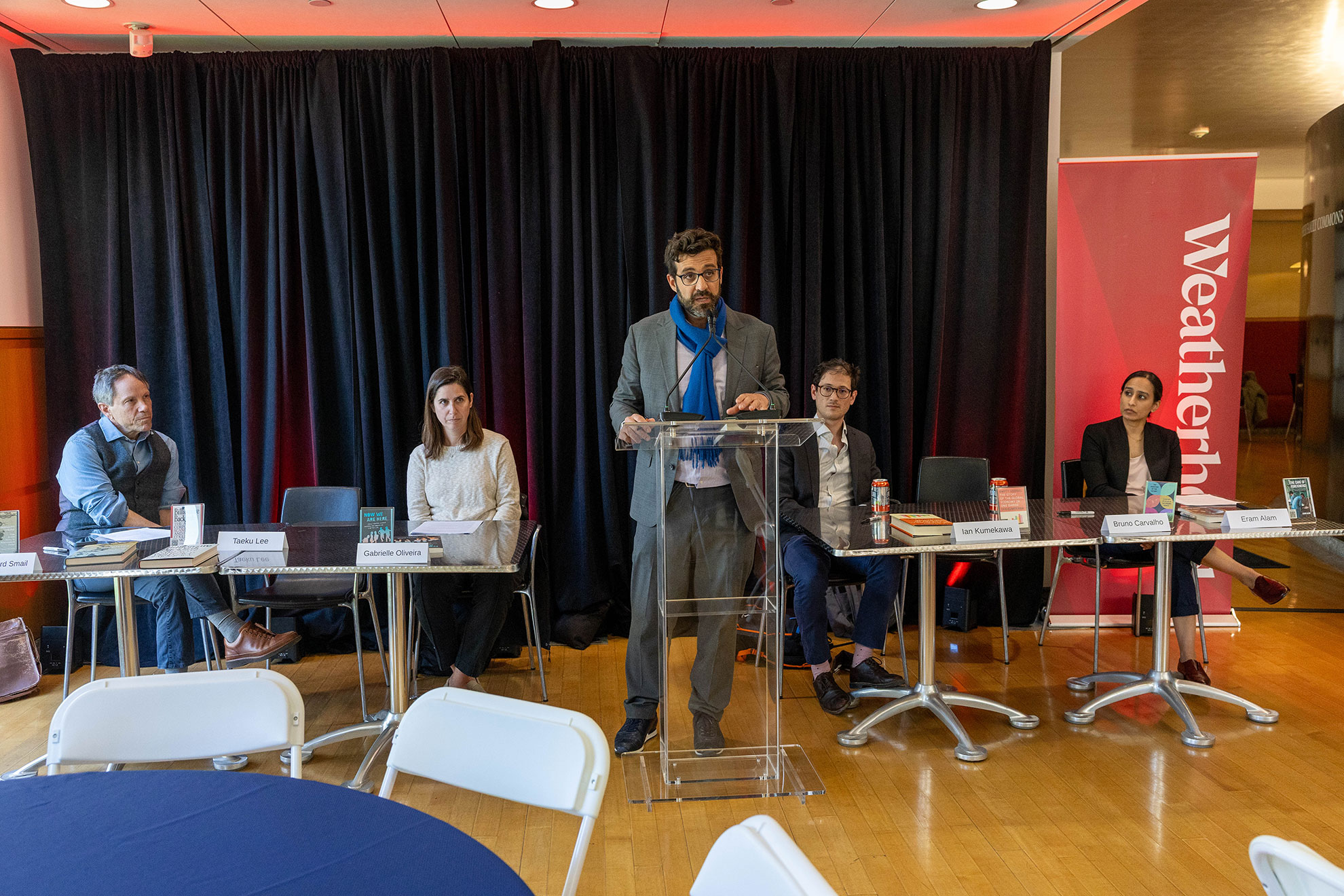
For around 60 years, immigrant doctors have played a crucial role in supporting healthcare in underserved urban and rural areas of the U.S., amid a shortage of primary care providers and the growth of government medical programs. Eram Alam explored this in her 2025 book “The Care of Foreigners: How Immigrant Physicians Changed U.S. Healthcare,” discussed at the Weatherhead Center for International Affairs’ International Book Blitz. Starting in the 1960s, many doctors from Asia and Africa were recruited to the U.S., partly due to concerns about these countries aligning with communism. This influx coincided with the introduction of Medicare and Medicaid and hospital desegregation, leading to a significant presence of immigrant doctors in primary care.
Despite their contributions, these physicians often faced racism within the medical community, which was skeptical of non-white professionals with accented English. Alam argues in her book for comprehensive reform of healthcare and immigration to ensure consistent medical care for all. Bruno Carvalho also spoke at the Blitz, sharing insights from his book “The Invention of the Future: A History of Cities in the Modern World.” His work traces urban evolution from 1755 Lisbon to post-WWII Lagos and Brasilia, examining how urban planning has unintended consequences. He notes that historical views on population density have shifted, with some modern planners advocating for increased density to address the housing crisis.
Ian Kumekawa discussed his book “Empty Vessel: The Story of the Global Economy in One Barge,” which began as a project during the COVID-19 pandemic. His interest was piqued by New York’s last prison ship, “The Boat,” and its historical parallels to the British carceral system. The barge’s journey across the globe highlighted its role in the offshore industry and global trade, offering a unique perspective on economic transformations over the past five decades.
Gabrielle Oliveira read from her book “Now We’re Here: Family Migration, Children’s Education and Dreams for a Better Life,” which centers on family migration and the pursuit of better opportunities. Through ethnographic research, she highlights the enduring trauma and resilience of families seeking improved lives and education for their children. A Brazilian teenager’s poignant question about the right to a good life underscores the book’s themes of dignity and aspiration.
The event concluded with Daniel Lord Smail discussing “Magdalena Coline: A Life Beyond Slavery in Mediterranean Europe.” Smail’s research, originating from a court case in 1400s Marseille, sheds light on the significant scale of the slave trade in the late Middle Ages. His findings challenge previous assumptions about the minor role of slavery in Europe, revealing complex connections to the Mongol empire and the Black Sea region.
Original Source: news.harvard.edu